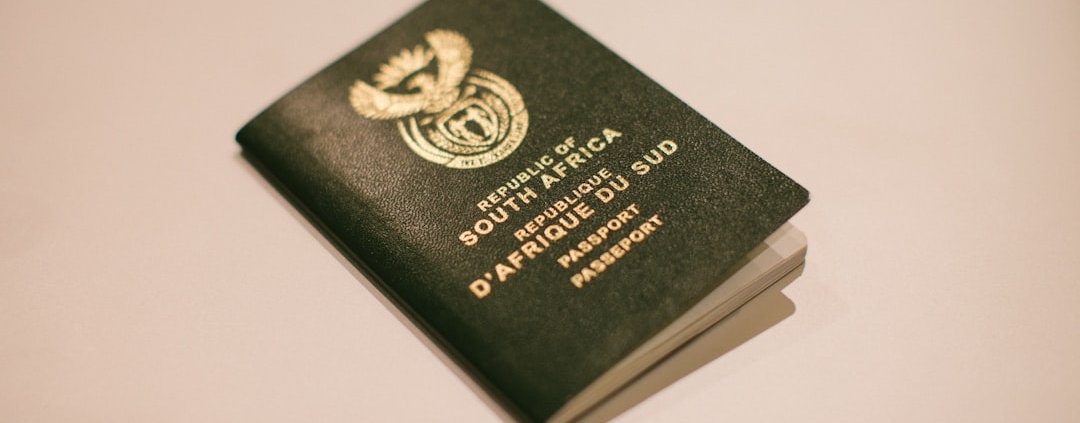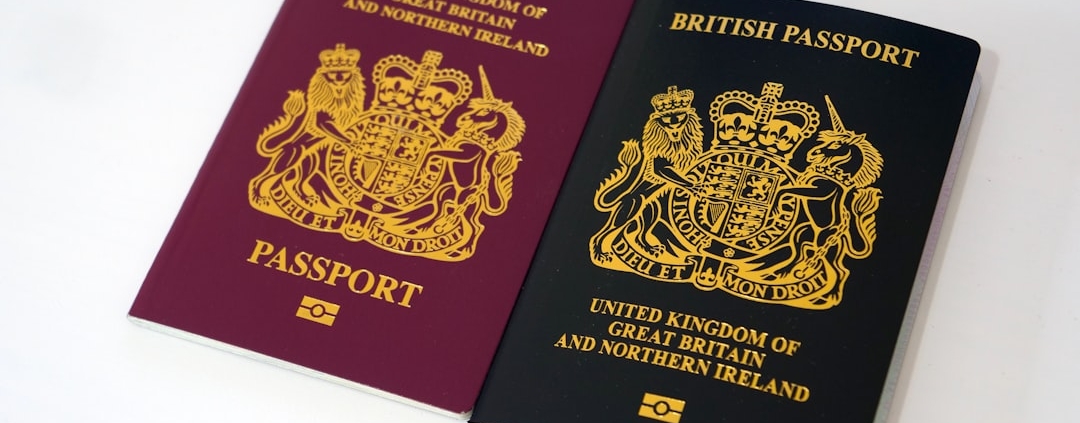

You’ve worked the points calculator, you’ve had a recruiter on a video call telling you the GP shortage / civil engineer shortage / chef shortage is real, and you’ve maybe even got an Accredited Employer Work Visa keeping the door open. Now comes the part nobody warns you about properly: the paper trail for your Skilled Migrant Category (SMC) application.

Immigration New Zealand (INZ) doesn’t ask for much that’s exotic. The list is shorter than what Australia or Canada wants. But the form those documents have to be in trips up almost every South African applicant we see, notarised when it shouldn’t be, apostilled when it didn’t need to be, translated by the wrong person, and six weeks lost.

Notary Requirements for the New Zealand Skilled Migrant Visa

The good news: New Zealand is a Hague country

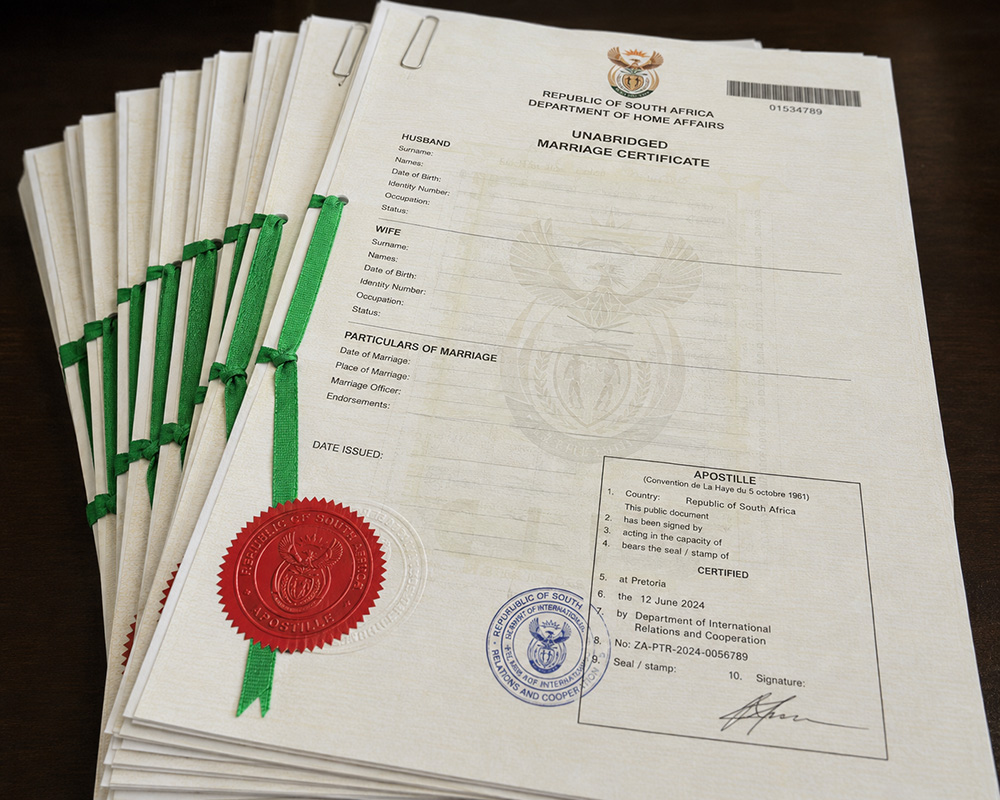
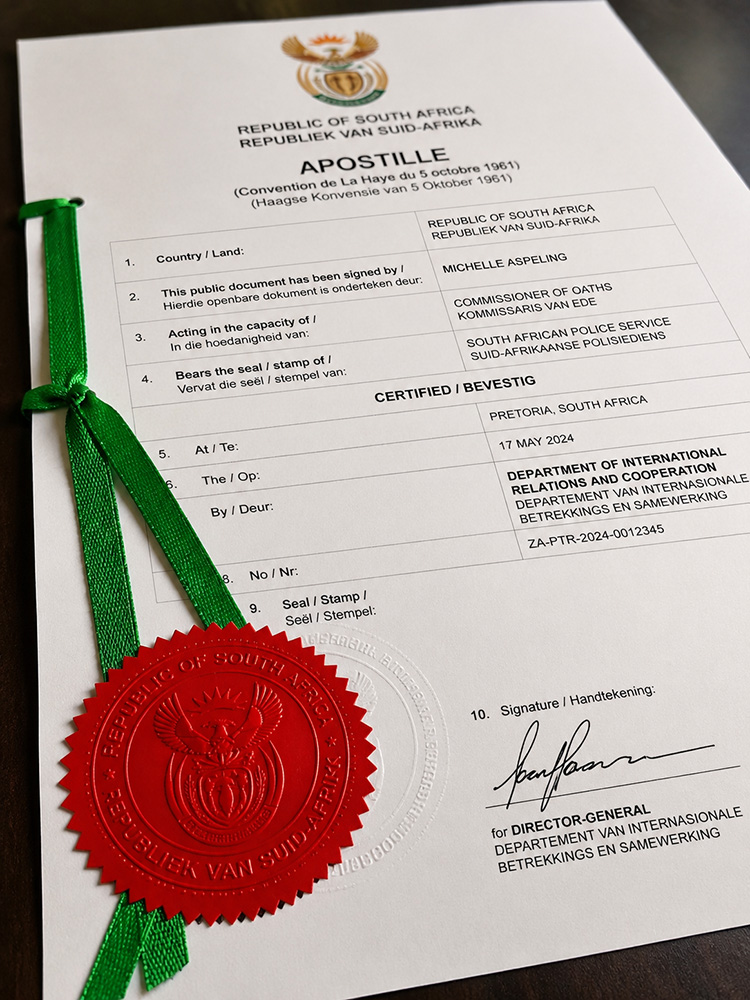
New Zealand joined the Hague Apostille Convention in 2001, and South Africa joined in 1995. That means a single apostille certificate from DIRCO or the High Court of South Africa is enough, INZ won’t ask you to send anything to the New Zealand High Commission for further legalisation.

Compare that to South Africans heading to the UAE or Saudi Arabia and you’ll appreciate the difference. One stamp, one route, done.

Where notarisation actually fits in

Here’s the thing INZ doesn’t shout about: a certified copy is enough for most documents. INZ accepts copies signed and stamped by an authorised certifier, a Commissioner of Oaths, a SAPS officer, a magistrate, or a notary public.

The notary becomes essential when the document needs to travel further than an INZ portal upload, typically because it’s heading for an apostille. Only certain signatures are on DIRCO’s specimen register, and a notary public’s is one of them. The friendly Commissioner of Oaths at your local Postnet generally is not. So if a document needs to be apostilled, the underlying certification has to come from someone DIRCO recognises.

The other place a notary is unavoidable is on private documents that don’t exist as government records, affidavits, statutory declarations, powers of attorney, sworn translations. Without a notary’s signature and seal, these don’t count.

The SMC document list, sorted

Here’s how the typical SMC bundle breaks down for a South African applicant.

Certified copies: apostille not needed

These get scanned and uploaded to your INZ portal. A notary or Commissioner of Oaths certification is fine.

  • Passport photo page and a recent passport-sized photograph
  • Job offer letter from your accredited New Zealand employer
  • Employment reference letters from past employers
  • CV and any supporting work history
  • IELTS or other English test results, INZ verifies these directly with the test provider
  • SARS earnings summary if you’re claiming work-experience points

Apostille recommended: straight from DIRCO, no notary first

These are state-issued public documents. INZ will technically accept certified copies, but applicants whose police clearance and qualification documents are apostilled tend to get fewer queries and faster decisions.

  • Unabridged birth certificate for you and any dependants
  • Unabridged marriage certificate, if you’re bringing a partner
  • Decree of divorce or death certificate of a former spouse, where applicable
  • SAPS police clearance certificate: must be less than 6 months old when you submit
  • Degree certificates and academic transcripts: needed for the NZQA International Qualifications Assessment (IQA), which most SMC applicants must complete first

Notarisation required, then an apostille

These are private documents. A notary drafts or witnesses them, signs and seals them, and only then can they be apostilled.

  • Affidavits: explaining gaps in employment, name changes, or relationship history
  • Statutory declarations: confirming identity details where birth records are incomplete
  • Powers of attorney: for someone in SA managing your bond, your tenants, or a sale while you settle in
  • Sworn translations: if any document is in Afrikaans or another language and the translator’s signature needs to be apostilled
  • Partnership/de facto declarations: if you’re including an unmarried partner

A useful rule of thumb: if a real person signed it on letterhead, it probably needs a notary. If a government department issued it with an embossed seal, it probably doesn’t.

Notary Requirements for the New Zealand Skilled Migrant Visa

A realistic timeline

This is where most SMC plans go sideways. Email-speed assumptions don’t survive contact with Home Affairs or SAPS.

  • Unabridged birth certificate from Home Affairs: 6 to 8 weeks if it has to be reissued
  • SAPS police clearance: 8 to 12 weeks during busy periods
  • NZQA International Qualifications Assessment: about 35 working days from a complete file
  • Notarisation: same-day for most jobs, if the notary is responsive
  • High Court apostille: roughly 3 working days
  • DIRCO apostille: 3 to 4 weeks normally, 6 to 8 weeks during peak

If you’ve got a job offer with a start date 90 days out, the SAPS clearance and the NZQA assessment are the bottlenecks. Start them first. Notarisation you can knock out in a single afternoon at the end.

What tends to derail SMC applicants

A few patterns we see almost every week:

  • Submitting the abridged birth certificate. INZ wants the unabridged version with both parents’ details. The short one Home Affairs prints by default doesn’t work.
  • Translations done by the wrong person. A friend who speaks Afrikaans isn’t enough. INZ wants a sworn translator, and if the translation is being apostilled, a notary’s certification of the translator’s signature.
  • Modifying an apostilled document — writing on it, stapling something to it, punching holes. The apostille certifies the document in its exact state at that moment. A new ink mark technically invalidates it.
  • Apostilling things that don’t need it. Your CV doesn’t need an apostille. Your job offer doesn’t either. DIRCO won’t even apostille them, because they aren’t on the recognised-signature register.
  • Forgetting third-country police clearances. If you’ve spent 12 months or more in any other country in the last 10 years ( UK, UAE, Australia ) INZ wants a clearance from each, legalised under that country’s own rules.

Where we fit in

Most of our SMC clients arrive in one of three states: they’ve gathered everything and want it notarised, certified, and apostilled in a single coordinated run; they’re stuck on a single problem like a missing birth certificate or an affidavit they don’t know how to draft; or they’re already in New Zealand and need a power of attorney for a family member back home to handle a sale or a bank matter.

For each, we work the same way, clear quote up front, all documents handled in-house by an admitted attorney and notary, courier to and from DIRCO or the High Court, and a digital scan of every legalised document so you have a record before the originals reach you.

If you’ve just had your Expression of Interest selected and you’re staring at the document list wondering what goes where, send us your INZ checklist on WhatsApp. We’ll map out the right route for each item and come back with a quote and a realistic timeline within one working day.

It’s one of those questions that sounds straightforward but trips people up the moment they’re standing in a notary’s office, document in hand, wondering if they brought enough warm bodies. Short answer: yes, a notary can witness signature, that’s actually a core part of what they do. But “witnessing” in the everyday sense (the person who scribbles their name in the witness box at the bottom of the page) and “witnessing” in the notarial sense are not the same thing, and conflating them is where the trouble starts.

Here’s how it actually works in South Africa.

What a notary does, in plain terms

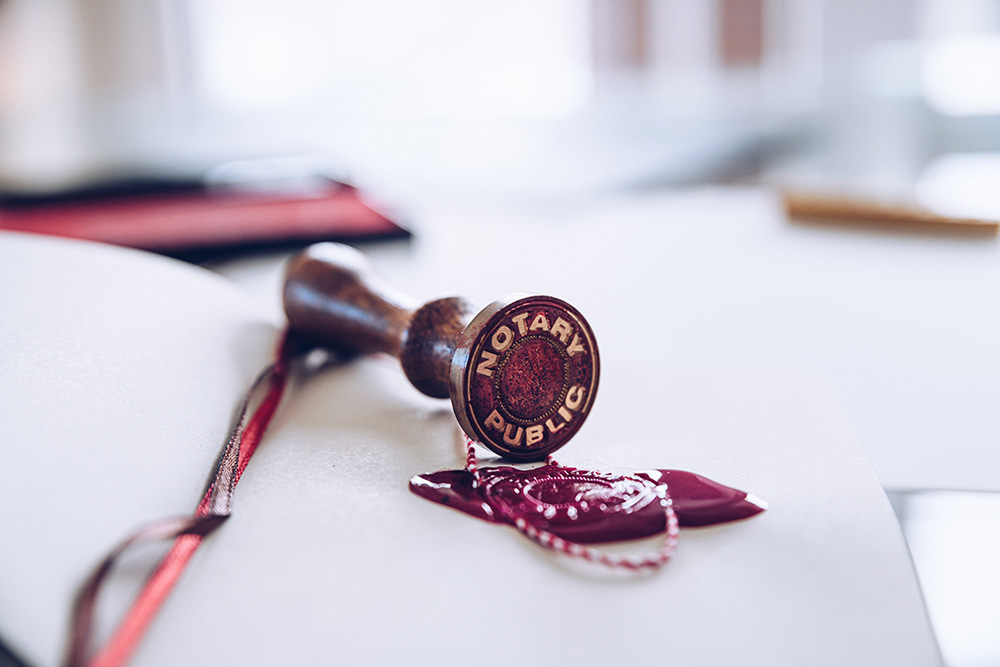
A notary public in South Africa is an admitted attorney who has gone the extra mile, additional study, a separate exam, and a formal appointment by the High Court. Their day job is authenticating signatures, verifying identity, attesting to the contents of documents, and putting their seal on paperwork that needs to carry weight beyond domestic borders.

When a notary watches you sign a power of attorney or an affidavit and then stamps it with that embossed seal, they are witnessing your signature. They sign their own name, they note the date, and they certify that you appeared in front of them, identified yourself, and signed of your own free will.

So if the question is “did the notary witness me sign?” then yes, by definition.

Can a notary also be a witness

Where the confusion creeps in

The trouble usually comes from documents that require independent lay witnesses in addition to the notary. Think wills, antenuptial contracts, certain consent letters, or documents going to specific foreign jurisdictions that demand two witnesses on top of notarial attestation.

In those cases, the notary’s role is the official one: they attest, certify, and seal. The two witness lines below your signature are meant for someone else, typically a person over the age of 14 who is competent to give evidence in court if it ever comes to that. The notary isn’t filling those slots.

It isn’t that they legally can’t in every situation. It’s that mixing the two roles defeats the point. A witness exists to provide independent corroboration: someone who saw you sign, who isn’t a party to the document, and who can later be called on to confirm what happened. The notary is already the certifying official, so asking them to also play one of the lay witnesses collapses two checks into one.

The antenuptial contract example

Antenuptial contracts are a useful example. Both parties have to appear in front of the notary, originals of identification in hand, and the contract is registered as a notarial deed. South African practice requires two competent witnesses, over 14, mentally capable, present at the signing, in addition to the notary executing the deed.

If you turn up alone with your fiancé and assume the notary will sign as witness, you’ll be asked to find someone else. The notary’s signature appears on the contract as the executing notary, not as one of the two witnesses. Many notary offices keep staff on hand precisely so clients aren’t left scrambling.

Affidavits and commissioners of oaths

Affidavits work differently. When you swear an affidavit before a commissioner of oaths, a magistrate, a SAPS officer, an attorney, or a notary acting in that capacity, there’s no separate “witness” line. The commissioner is the one witnessing your oath, and their signature and stamp do the work.

If a form has a witness block sitting above the commissioner’s section, that’s a sign the document was probably designed for a different purpose. Have a chat with the receiving institution before you sign anything, pre-signed forms are one of the most common reasons appointments have to be redone.

Documents going overseas

This is where Quick Notary sees the most uncertainty. Foreign jurisdictions don’t all want the same thing. Some Hague Convention countries are happy with a notary’s attestation followed by an apostille. Others want two independent witnesses on the document itself, plus the notarial certificate, plus an apostille or authentication on top.

A US power of attorney, for instance, may require two witnesses and notarial acknowledgment. A document destined for the UAE will go a different route entirely, ending in DIRCO authentication and embassy legalisation. The signing requirements for the destination country dictate whether you need extra witnesses, not the notary’s preference.

The practical upshot: ask before you sign. The receiving party, the bank, the court, the immigration office, knows what its own procedures require, and a quick email confirming the format saves a return trip.

Can the notary’s staff witness?

Yes, and it’s common practice, provided they are competent adults who actually saw you sign. They aren’t parties to the document and have no interest in its outcome, which makes them suitable independent witnesses. Notaries who handle a lot of cross-border work tend to have at least one or two staff members ready to step in.

Family members can also witness in most cases, but be cautious with documents like wills, where a witness who is also a beneficiary risks invalidating their own bequest. When in doubt, lean on a neutral third party.

A simple way to think about it

Picture two distinct jobs at the same signing:

  • The notary is the official: they verify who you are, watch the signature happen, and put their seal on the result so it’s recognised abroad.
  • The witnesses are the lay observers: ordinary, unconnected people who can later confirm the signing took place.

A notary always does the first job. Whether the second job is also needed depends on the document and where it’s going.

When to call ahead

If you’re not sure what your document requires, send a scan to the notary’s office before your appointment. A quick read-through usually surfaces whether you need to bring witnesses with you, or whether the notary’s office can cover that part. It’s a five-minute conversation that prevents the much longer scramble of organising a second visit because something was missing.

Quick Notary handles signings, witnessing arrangements, and the full apostille and authentication process for documents heading overseas. If you’d like a hand sorting out exactly what your document needs, and who needs to sign where, get in touch and we’ll talk it through before you commit to anything.

The Golden Visa offer arrives at the end of a long week. A recruiter in Dubai Marina has lined up a senior engineering role, the salary clears the AED 30,000 threshold, and the company says they’ll sponsor the application “as soon as you send through your attested documents.” You assume that means a quick run to DIRCO. It doesn’t.

The UAE is one of the trickier destinations for South African paperwork, mostly because it sits outside the Hague Apostille Convention. That single fact changes the route, the cost, and the timing for every document you submit. Here’s how the chain actually works and what you’ll need in the pack.

First, a quick myth-buster: it isn’t really an apostille

Most South Africans use “apostille” as shorthand for any document legalisation. For Hague countries (the UK, Canada, Germany, the Netherlands and 120 others), that’s accurate. For the UAE, it isn’t.

The UAE has not signed the Hague Convention, so DIRCO won’t apostille a document for Dubai. Instead, DIRCO issues a Certificate of Authentication, which then has to be attested by the UAE Embassy in Pretoria, and finally re-attested by MOFAIC (the UAE’s Ministry of Foreign Affairs and International Cooperation) once the document lands in Dubai. Three stamps, three offices, three queues.

If a service provider quotes you “an apostille for Dubai,” ask them which embassy step they’re including. The answer tells you whether they actually know the route.

Apostille for the Dubai Golden Visa A South African Document Checklist

The Golden Visa categories, and which one drives your document list

The documents you need depend on the route you qualify under. The four most common for South Africans are:

  • Skilled Professional: Bachelor’s degree, monthly basic salary of at least AED 30,000, an employment contract, and a job classified at MoHRE Level 1 or 2 (engineers, doctors, IT specialists, legal consultants and similar)
  • Investor: AED 2 million in property (completed, not off-plan, held for at least two years) or in a regulated UAE investment fund
  • Entrepreneur: a project valued at AED 500,000 minimum with approval from an accredited UAE business incubator
  • Exceptional Talent: endorsement from a UAE federal authority (Ministry of Culture for artists, Ministry of Economy for inventors, General Authority of Sport for athletes, and so on)

Each route has its own evidence pack, but a substantial chunk of the paperwork is shared.

The shared core: documents almost every applicant needs

Whichever category you go for, expect the following to be on the embassy’s list.

Personal civil documents

  • Unabridged birth certificate from Home Affairs, with the embossed seal
  • Unabridged marriage certificate if your spouse is joining you
  • Decree of divorce if previously married and you’re including a new partner
  • Police clearance certificate from SAPS, original document only
  • Notarised copy of your passport with all data pages and any used visa pages

Educational documents

  • Original degree certificate from a recognised South African university
  • Academic transcript for the same qualification
  • SAQA evaluation (the South African Qualifications Authority assessment confirming the level and accreditation of your degree)
  • MoE equivalency certificate – issued by the UAE Ministry of Education in Dubai once your degree lands there, but you can’t apply for it until your SA documents have cleared the embassy chain

The MoE equivalency rule has tightened. Since late 2024, Dubai’s GDRFA has been requesting equivalency certificates for a wider band of Skilled Professional and Specialist applications, and a missing equivalency is now one of the most common reasons a Golden Visa file gets parked.

Employment and financial documents

  • Employment contract signed by both parties, on company letterhead
  • Salary certificate or recent payslips confirming the AED 30,000 threshold
  • Letter from your current SA employer confirming role, tenure and salary, if you’re transferring within a group
  • Bank statements for the past six months
  • For investors: title deeds, share certificates, audited financials, or fund statements

Sorting the pack: what gets notarised and what doesn’t

A few rules worth memorising before you start.

Goes straight to DIRCO (no notary needed, because the document is already a state-issued original):

  • Unabridged Home Affairs certificates
  • SAPS police clearance with the embossed seal
  • Degree and transcript with original university signatures and seals (most public universities qualify, but check)

Needs notarisation first, then DIRCO authentication, then embassy attestation:

  • Passport copies
  • Affidavits and statutory declarations
  • Powers of attorney (often used so a family member can finalise property transfers, tax matters or a vehicle sale while you’re settling in Dubai)
  • Translations into Arabic if any document is in Afrikaans only (rare, but it happens with older qualifications)
  • Employer letters, accountant letters, salary certificates from private companies – anything signed by a person rather than a state authority

The general rule: if a real human signed it on letterhead, it needs a notary first. If a department issued it with a seal, it usually doesn’t.

The chain, stamp by stamp

Here’s the path each document follows, in order:

  1. Notarisation by a South African notary public (an admitted attorney with extra qualifications) – only required for private documents
  2. DIRCO authentication in Pretoria, which produces the Certificate of Authentication
  3. UAE Embassy attestation in Pretoria, which adds the embassy stamp and is the step that distinguishes UAE paperwork from Hague-country paperwork
  4. MOFAIC attestation in the UAE itself, usually handled by your sponsor, your PRO, or a Dubai-based service once the documents arrive

Skip a stamp and the next office in the chain will simply hand it back. There is no shortcut.

Realistic timing

A planning rule for Golden Visa applicants:

  • SAPS police clearance: 14 to 20 working days
  • Notarisation: same day for most jobs
  • DIRCO authentication: 5 to 10 working days
  • UAE Embassy attestation in Pretoria: 3 to 7 working days
  • MOFAIC in the UAE: 2 to 5 working days

Add international courier and you’re looking at four to seven weeks for the full chain on a normal run. Plan for longer if your SAPS application catches a fingerprint backlog or your degree is from a private institution that takes its time releasing originals.

Cost-wise, the embassy charges AED 150 per ordinary document and AED 2,000 per commercial document, payable in rand at the prevailing rate, on top of the DIRCO and notary fees.

What tends to derail Golden Visa applications

A few patterns we see almost weekly:

  • Submitting an apostille (instead of an authentication) and being turned away at the embassy
  • Sending an abridged birth certificate to DIRCO ( only unabridged originals are accepted ).
  • Forgetting the SAQA evaluation, which the embassy expects to see clipped to the degree pack
  • Trying to attest a salary letter that’s been signed digitally only, with no wet-ink signature for the notary to verify
  • Leaving translation until the embassy stage, when it should happen before notarisation

Most of these add two to three weeks each. Stack two of them and your start date in Dubai starts to slide.

Where we fit in

Quick Notary handles the full UAE chain for Golden Visa applicants, notarising what needs notarising in-house, running documents through DIRCO and the embassy in Pretoria, and couriering the finished pack to your sponsor or PRO in Dubai, Abu Dhabi or Sharjah. Our notaries are admitted attorneys, which the embassy and DIRCO both require.

If your offer letter has just landed and you’re staring at the embassy’s checklist wondering where to start, send it to us on WhatsApp and we’ll map out the right route for each document, including which items need a SAQA evaluation, which need a notary, and which can skip straight to authentication. The planning call costs you nothing and tends to save the kind of timing scramble that makes a relocation date wobble.

If you’ve been told you need an affidavit, your first instinct is probably to head to the local police station or magistrate’s court, sign a sworn statement in front of a friendly official, and call it done. That works perfectly well for most South African admin. But if the affidavit is heading overseas, that same document can come back rejected and useless.

The reason comes down to who watched you sign. A magistrate’s affidavit and a notary’s affidavit are both sworn statements, both signed under oath, both stamped on completion. Legally, though, they sit in two different lanes, and getting the wrong one is one of the most common reasons people end up in our office for a redo.

Here’s what actually separates them, and how to tell which one your situation calls for.

What an affidavit is, briefly

An affidavit is a written statement of fact that you swear, under oath, to be true. Lying on one is a criminal offence, which is why courts, banks, government departments, and foreign authorities treat them as serious evidence. The substance of the statement is your business. The legal weight comes from being signed in the presence of someone the law authorises to administer the oath.

That’s where the two paths diverge.

The magistrate (commissioner of oaths) affidavit

When most South Africans say “magistrate affidavit”, they really mean any affidavit signed before a Commissioner of Oaths. Magistrates are commissioners of oaths automatically, by virtue of office, but so are a long list of others under the Justices of the Peace and Commissioners of Oaths Act:

  • SAPS officers above a certain rank
  • Postmasters
  • Bank managers
  • Certain government officials
  • Attorneys, advocates, and notaries

In practice, most people walk into a police station or a magistrate’s court and have it sorted in twenty minutes. There’s no fee. Commissioners of oaths are not allowed to charge for the service.

A commissioner of oaths affidavit is recognised inside South Africa for nearly every domestic purpose: SARS submissions, Home Affairs declarations, RAF claims, lost-document reports, lease agreements, and routine court matters. For staying within the country, it does the job.

The catch is geographic. Commissioners of oaths perform their duties for use within the Republic. The moment your document crosses a border, the commissioner’s stamp loses its weight.

The notary affidavit

A notary affidavit is sworn before a Notary Public. Every notary is also a commissioner of oaths, but the reverse isn’t true. Becoming a notary requires being an admitted attorney, then completing further legal study, passing a separate notarial examination, and being formally appointed by the High Court of South Africa. It’s a meaningfully higher bar.

When a notary attests to your affidavit, they verify your identity, witness your oath, and then attach a notarial certificate, signature, and embossed seal. That seal is the part that matters internationally. It’s the recognised mark that lets DIRCO, foreign embassies, and overseas institutions trust that the document was properly executed in South Africa.

A notary affidavit is also the starting point for legalisation. If your document needs an apostille for a Hague Convention country, or authentication for a non-Hague country, neither DIRCO nor the High Court will issue one on a document that hasn’t first been notarised. Skipping the notary step isn’t a shortcut, it’s a dead end.

Notaries charge for their work. Fees vary, but expect a few hundred rand for a standard affidavit, more for complex documents.

The differences that actually matter

Strip away the legal terminology and a few practical differences are what cause real problems for real people.

Who signs it

A magistrate or police affidavit can be witnessed by anyone holding a commissioner of oaths designation. A notary affidavit must be witnessed by an attorney admitted as a notary by the High Court.

Where it’s accepted

Magistrate or police affidavits work inside South Africa. Notary affidavits are the version foreign governments, foreign courts, foreign universities, and overseas employers will recognise.

What you can do with it next

A notary affidavit can be apostilled by DIRCO or authenticated by the relevant embassy. A magistrate affidavit can’t. If you go that route and then need legalisation, you’ll be redoing the affidavit before a notary anyway.

Cost

Commissioner of oaths affidavits are free by law. Notary affidavits carry a professional fee.

Liability

Notaries carry personal legal liability for what they certify. They can be sued, sanctioned, or struck off the roll for dishonest or negligent work. That accountability is part of why their seal travels.

When to use which

For domestic matters that stay in South Africa, a commissioner of oaths is enough. Address confirmations for the bank, lost-ID declarations to Home Affairs, supporting affidavits for a small civil claim, sworn statements for SARS, none of these need a notary, and paying for one is just paying for an upgrade you won’t use.

If the affidavit is going abroad in any form, you need a notary. That includes:

  • Visa and immigration applications
  • Foreign property purchases or transfers
  • Overseas court proceedings or family law matters
  • Enrolling a child at a foreign school
  • Sponsorship affidavits for relatives abroad
  • Statements supporting a foreign business transaction

In almost every one of those cases, the notarised affidavit will then need an apostille or authentication before it’s accepted. The notary stamp is step one, not the finish line.

The mistake we see most often

The painful version of this is the person who gets their affidavit done at the police station on a Saturday, couriers it overseas the following week, and only finds out at the foreign end that the document carries no international weight. By that point they’re paying for a second courier, redoing the affidavit before a notary, paying for the apostille, and missing whatever deadline the original document was meant to satisfy.

Asking the receiving party ( the embassy, the foreign attorney, the overseas employer ) exactly what form they need before you sign anything is the fastest way to avoid that loop. The answer almost always settles it.

Not sure which one you need?

If your affidavit is staying in the country, the police station or magistrate’s court will sort you out in a morning. If it’s heading anywhere else, or you’re not sure, talk to us first.

Quick Notary handles notarial affidavits, apostilles, and authentications for South Africans every day, both at home and abroad. We can tell you in one conversation whether your document needs a notary, a commissioner of oaths, or something more involved, and we’ll handle the legalisation leg if it does. Get in touch before you sign, and you’ll only need to do this once.

You’ve got the Certificate of Sponsorship in your inbox, the start date is six weeks out, and your new manager in Manchester is already asking about onboarding. Then comes the email from your immigration solicitor: please send the apostilled originals of the following documents. Just like that, your Skilled Worker visa application has turned into a paperwork project you didn’t plan for.

The UK is one of the easier destinations for South African paperwork, but only if you understand which documents need to be notarised, which need to be apostilled, and in which order. Get the order wrong and your visa lodgement slips by weeks.

The good news: the UK is a Hague country

The UK has been part of the Hague Apostille Convention since 1965, and South Africa joined in 1995. That means a single apostille certificate from DIRCO or the High Court of South Africa is enough, UK Visas and Immigration won’t ask you to send anything to the British High Commission for further legalisation.

Compare that to South Africans heading to the UAE or Saudi Arabia for a similar role and you’ll appreciate the difference. One stamp, one route, done.

When notarisation comes into the picture

Apostille and notarisation aren’t the same thing, and people lose weeks confusing the two.

An apostille is a government-issued certificate that confirms the official document underneath it is genuine. DIRCO and the High Court can apostille public documents ( things issued by Home Affairs, SAPS, or a recognised university) directly.

Notarisation happens before that. A notary public (an admitted attorney with extra qualifications) certifies private documents, copies, signatures, or sworn statements so that they become eligible for an apostille. The High Court will only apostille a document that has a notary’s signature and seal on it. DIRCO will only apostille originals issued by the state.

So the question for every document on your Skilled Worker pack is: does this go straight to DIRCO, or does it need a notary first?

The Skilled Worker document list, sorted

Here’s how the typical Skilled Worker bundle breaks down for a South African applicant.

Goes straight for an apostille (no notary needed)

  • Unabridged birth certificate: original from Home Affairs, for you and any dependants
  • Unabridged marriage certificate: if you’re bringing a spouse
  • Decree of divorce: if you’ve been married before and your new partner is on the application
  • South African Police Clearance Certificate: original SAPS document with the embossed seal
  • Degree certificates and academic transcripts: only if issued by a public South African university with original signatures and seals (private institutions and older qualifications often need a notary first)

Needs notarisation first, then an apostille

  • Sworn affidavits: for example, confirming cohabitation history or a name change
  • Notarised copies of your passport: UK Visas and Immigration sometimes want a certified copy if your original is in use elsewhere
  • Powers of attorney: typically for someone in SA managing your bond, your tenants, or a sale while you settle in the UK
  • Translations: if any document is not already in English (rare for South African paperwork, but it happens with older Afrikaans-only certificates)
  • Letters from former employers, accountants, or universities: the notary verifies the signatory’s identity and signature
  • Statutory declarations: used for things like single-status confirmation or proof of dependant relationships

A useful rule of thumb: if a real human signed it on company letterhead, it probably needs a notary. If a government department issued it with a seal, it probably doesn’t.

Notarising Documents for the UK Skilled Worker Visa

Documents the Skilled Worker route doesn’t actually need apostilled

Some documents UK Visas and Immigration ask for don’t need any of this faff at all. Your Certificate of Sponsorship is a digital reference number, there’s nothing to apostille. Your TB test certificate comes from a Home Office-approved clinic in Sandton or Cape Town and goes in as-is. Your financial evidence showing the £1,270 sat in your account for 28 days is just a bank statement.

The trap is that people assume everything needs an apostille and end up paying to apostille things that should have stayed plain. Save yourself the cost.

Timing and why it bites

UK Skilled Worker applications run on a 90-day window from the date your CoS is issued, which sounds generous until you’re chasing a SAPS fingerprint result.

A realistic timeline for South African applicants:

  • SAPS police clearance: 14 to 20 working days for the certificate itself
  • Notarisation: same-day for most jobs, if the notary is responsive
  • High Court apostille: roughly 3 working days
  • DIRCO apostille: 3 to 4 weeks on a normal week, 6 to 8 weeks during peak periods

The High Court route is faster but only available for documents that have been notarised first. DIRCO is the only route for state-issued originals like Home Affairs certificates and SAPS clearances.

Don’t ignore what’s happening on the UK side either. The general salary threshold sits at £38,700 and is set to climb to £41,700, and policy keeps tightening. The faster you submit, the less rule-shifting you have to manage.

What tends to derail people

A few patterns we see almost every week:

  • Applying for the apostille before the document was properly notarised. The High Court rejects it, two weeks gone.
  • Sending an abridged birth certificate to DIRCO. Since the September 2024 tightening, only unabridged originals are accepted.
  • Booking the TB test before checking the clinic is on the Home Office list — results from anywhere else are invalid.
  • Assuming a JP-certified copy will work. JPs can certify for South African purposes, but UKVI and DIRCO want a notary’s seal.
  • Leaving the apostille step until after lodgement, then scrambling when the Home Office requests originals.

Most of these are five-minute mistakes that cost three weeks to undo.

Where we fit in

Quick Notary handles the whole chain for Skilled Worker applicants, notarising what needs notarising in-house (our notaries are admitted attorneys), running documents to DIRCO or the High Court, and couriering finished packs to wherever you are. London, Edinburgh, Belfast, Aberdeen, we’ve shipped to all of them, and to a fair few villages no one outside the UK has heard of.

If you’ve just received your CoS and you’re staring at the document list wondering what goes where, send us your sponsor’s request list on WhatsApp and we’ll map out the right route for each item. A planning call costs you nothing, and tends to save the kind of timeline panic that makes the start date wobble.

You’ve spent eighteen months building your Express Entry profile. The CRS score finally clears, the IELTS is filed, and then it lands: an Invitation to Apply from IRCC, with a 60-day clock attached. Suddenly the bottleneck isn’t your score, it’s a stack of South African documents that need to be authenticated correctly before they’re worth anything in Ottawa.

The good news for South Africans applying for Canadian permanent residence (PR)  is that the authentication route in 2026 is dramatically simpler than it was two years ago. The bad news is that most online guides still describe the old one.

Canada is now a Hague country

The biggest change happened on 11 January 2024, when Canada joined the Hague Apostille Convention. South Africa has been a member since 1995. Before Canada’s accession, a South African document destined for IRCC had to be authenticated by DIRCO and then legalised by the Canadian High Commission in Pretoria.

Two queues, Two fees, Two timelines.

That second step is gone. A South African public document with a single apostille from DIRCO or the High Court is now legally recognised in Canada without any further consular step. If you’re reading older blog posts that describe sending things to the Canadian High Commission, ignore them.

Document Authentication for Canadian Express Entry Applicants

Apostille vs notarisation: which one your document needs

People lose weeks confusing these two. They are not interchangeable.

An apostille is a government-issued certificate that confirms the underlying document is genuine. It’s attached by either DIRCO or the High Court of South Africa, depending on the document type.

Notarisation happens before an apostille. A notary public — an admitted attorney with extra qualifications — certifies private documents, copies, signatures, or sworn statements so they’re eligible for an apostille at all. The High Court won’t apostille anything that doesn’t already carry a notary’s seal. DIRCO won’t apostille a notarised document; it only handles state-issued originals.

So for every Express Entry document, the question is: does this go straight to DIRCO, or does it need a notary first?

The Express Entry document list, sorted

Here’s how the typical IRCC bundle breaks down for a South African applicant.

Goes straight for an apostille at DIRCO

  • Unabridged birth certificate: original from Home Affairs, for you and any dependants
  • Unabridged marriage certificate: if you’re including a spouse
  • Decree of divorce: if you’ve been married before and your current partner is on the application
  • South African Police Clearance Certificate: original SAPS document with the embossed seal
  • Degree certificates and academic transcripts: only if issued by a public South African university with original signatures and seals

Needs notarisation first, then a High Court apostille

  • Sworn affidavits: for example, explaining a name change, an employment gap, or a missing document
  • Notarised copies of your passport: IRCC sometimes wants a certified copy when the original is needed elsewhere
  • Powers of attorney: for a family member or attorney managing property, banking, or further document requests after you leave
  • Reference letters from past employers: the notary verifies the signatory’s identity and signature
  • Translations: uncommon for South African paperwork in English, but Afrikaans-only certificates from older marriages or qualifications do come up
  • Statutory declarations: for things like single-status confirmation or dependent relationship proof

Useful rule of thumb: if a state department issued it with a seal, DIRCO. If a real human signed it on letterhead, a notary first.

Documents Express Entry doesn’t actually need apostilled

A surprising amount of the IRCC pack needs no authentication at all, and people waste money apostilling things that should stay plain.

The Educational Credential Assessment report from WES is generated in Toronto, nothing to apostille on the South African side. WES requests transcripts directly from your university, so the original transcript usually doesn’t need a notary either. Your language test results (IELTS, CELPIP, TEF) come from the testing body in a format IRCC already trusts. Your proof of funds is a bank letter and statements, submitted as-is.

Save the apostille fees for the documents that actually need them.

A realistic timeline

The 60-day post-ITA window sounds generous until you map it against South African processing times.

  • SAPS police clearance: officially 14 working days, realistically 8 to 12 weeks when SAPS is busy. Start this before your ITA arrives.
  • Unabridged Home Affairs certificates: 6 to 8 weeks if you don’t already have them. Order early.
  • Notarisation: same day for most jobs.
  • High Court apostille: roughly 3 working days.
  • DIRCO apostille: 3 to 4 weeks on a normal week, 6 to 8 weeks during peak periods.
  • International courier to Canada: 3 to 5 working days with tracking.

If your police clearance and unabridged certificates aren’t already in motion when the ITA email arrives, the 60-day deadline becomes uncomfortably tight. Applicants who submit on time almost always started the document side the moment their CRS score crossed the cut-off range, not the moment they were invited.

What trips Express Entry applicants up

A few patterns we see week after week:

  • Sending an abridged birth or marriage certificate to DIRCO. Only unabridged originals are accepted, and Home Affairs queues are not forgiving.
  • Getting a document apostilled, then making a change to it, adding a witness signature, signing a fresh page, which voids the apostille.
  • Using a Commissioner of Oaths for an affidavit that the High Court will only apostille if it has a notary’s seal.
  • Apostilling a transcript that WES is going to request directly anyway.
  • Forgetting that translations may need to be notarised separately, depending on how IRCC wants them presented.
  • Letting the SAPS clearance expire mid-process. Most provinces give it a 6-month shelf life for IRCC purposes, so the order of operations matters.

Almost all of these are five-minute decisions that cost three weeks to undo.

A note on documents from third countries

If you’ve lived in another country for more than six months in the last ten years, common for South Africans ( with stints in the UAE, the UK, or Saudi Arabia ) IRCC will want a police clearance from there too. Authentication for those follows the issuing country’s rules, not South Africa’s. We can usually point you in the right direction even when the document isn’t ours to authenticate.

Where we fit in

Quick Notary handles the South African leg of Express Entry document packs every week, notarising what needs notarising in-house (our notaries are admitted attorneys), running originals to DIRCO or the High Court, and couriering finished bundles to Toronto, Vancouver, Calgary, or wherever your settlement plan lands.

If your ITA has just arrived and you’re staring at IRCC’s checklist trying to work out what goes where, send us the list on WhatsApp. We’ll map the right route for each item, flag what you can start in parallel, and give you a realistic finish date inside the 60-day window. A planning call costs nothing, and it’s usually the difference between a calm submission and a courier panic at week eight.

What documents do I need for a notary in South Africa?

Showing up at a notary without the right paperwork is the quickest way to waste a morning. A notarisation only holds up if the notary can verify who you are and confirm the document in front of them is the real thing, so the admin you bring matters as much as the document itself.

Here’s what a South African notary public will expect you to hand over, plus the extra paperwork needed for specific jobs like antenuptial contracts, powers of attorney, and documents headed overseas.

The basics: what every notarial appointment needs

Whatever you’re having notarised, a South African notary public will always ask for three things:

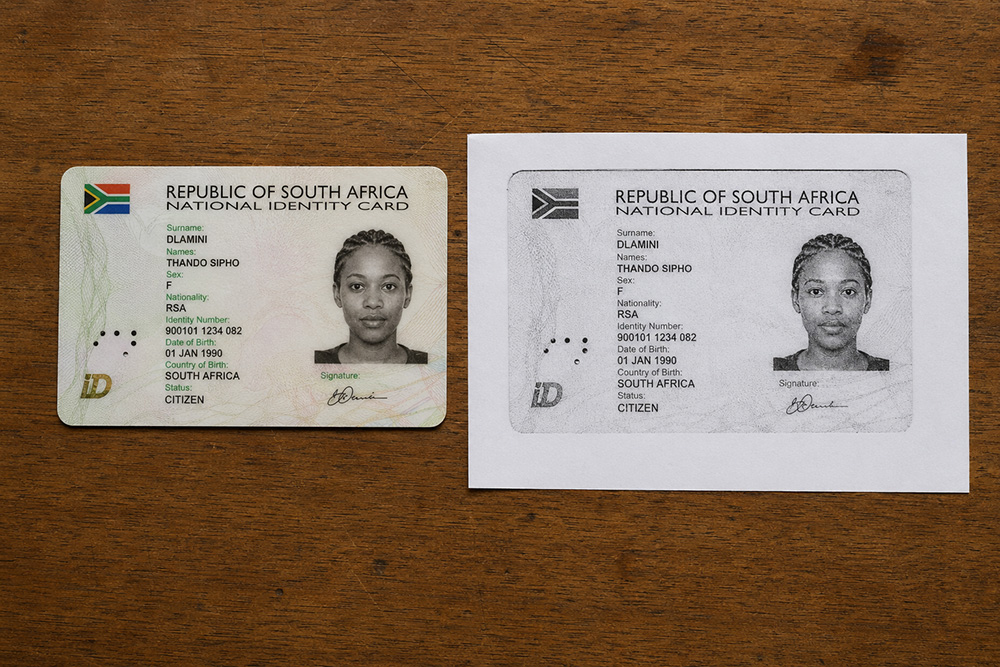
  • A valid, government-issued ID. Usually your green ID book, Smart ID card, or current passport.
  • The original document. Not a photocopy, scan, or printout of a scan.
  • You, in person, for most jobs. Identity checks can’t be done over email, and a notary has to witness your signature for it to carry weight.

Without those three, the appointment effectively doesn’t happen. Everything else below is an add-on depending on what you’re signing.

What documents do I need for a notary in South Africa

Proof of identity

Your ID is the notary’s anchor for the whole act. They’ll check it, record the details, and usually photocopy it for the file. Acceptable options are:

  • South African green ID book
  • Smart ID card
  • Valid South African passport
  • For foreign nationals: a current passport plus the relevant visa or permit

Expired IDs are a hard no, even if it’s the one you’ve been using for years. If the name on your ID doesn’t match the name on the document (common after marriage or divorce), bring the marriage certificate or divorce order so the notary can link them.

Because notaries fall under FICA, some will also ask for proof of address no older than three months. A utility bill, bank statement, or municipal rates account works. If you don’t have anything in your name, an SAPS-stamped affidavit confirming where you live is a reliable fallback.

The document itself

The document must be final, complete, and unsigned where a notarial signature is required. Notaries can’t sign over blanks, and they won’t certify a document you’ve already signed at home if the notarial wording says the signature has to happen in their presence.

If your document refers to other paperwork, like a title deed, a company resolution, or a court order, bring the originals of those too. The notary may need to reference or attach them.

Common notarial jobs and what else to bring

Affidavits and sworn statements

Bring the unsigned affidavit and your ID. That’s usually it. If the affidavit refers to supporting evidence, have it on hand in case the notary wants to attach a certified copy.

Powers of attorney

For a general or special power of attorney:

  • The draft POA, ideally prepared by an attorney
  • Your ID
  • The full names, ID numbers, and contact details of the person you’re appointing
  • If the POA is heading overseas, the name of the destination country so the notary can include the correct legalisation wording

Antenuptial contracts

Both future spouses must attend together, both carrying original IDs. You’ll also need your intended wedding date and a clear picture of any assets, debts, or inheritances you want covered in the contract. Two competent witnesses over 14 are required, though the notary’s office can usually provide them. The contract has to be signed before the wedding and lodged at the Deeds Office within three months of signing, so leave yourself a buffer.

Certified copies for overseas use or apostille

If you’re preparing documents for a Hague apostille through DIRCO or the High Court, bring the original issuing-authority document, the one with the actual seal, not a copy of a copy:

  • Unabridged birth, marriage, or death certificates from Home Affairs
  • Original police clearance from SAPS
  • Original academic transcripts and degree certificates from the university
  • Letters of no impediment issued by Home Affairs

For academic documents, some universities issue sealed transcripts directly. Those usually need to be opened in front of the notary, not before. Foreign-language documents may also need a sworn translation attached before they’ll be accepted abroad.

Company and corporate documents

If you’re signing on behalf of a business, the notary needs proof you’re authorised to do so:

  • Your ID
  • The company’s CIPC registration certificate
  • A board or directors’ resolution naming you as signatory
  • Memorandum of Incorporation, if the resolution refers to it

For foreign transactions, add anything the receiving jurisdiction has asked for: a certificate of good standing, shareholder register, or tax clearance.

Travel consent for minors

  • Both parents’ IDs, or one parent’s ID plus custody or guardianship documents
  • The child’s unabridged birth certificate
  • The draft consent letter with the travel dates and destination

What trips people up

A handful of small things cause most rejected notarisations:

  • Expired IDs and passports
  • Documents signed in advance of the appointment
  • Photocopies where the foreign authority expects originals
  • Name mismatches between ID and document, with no supporting certificate to explain the change
  • Foreign-language documents sent in without a sworn translation

It’s worth emailing scans through ahead of your appointment so the notary can flag any of these before you drive across town.

Make the appointment a one-trip job

Quick Notary’s team reviews your paperwork before you arrive, tells you exactly which originals to bring, and handles the apostille or authentication leg if your documents are bound for use overseas. That saves a return trip, and more importantly, stops a foreign consulate or DIRCO counter from bouncing your paperwork weeks down the line.

If you have a notarisation coming up and you’re not sure what to bring, send the document through. We’ll tell you what’s needed, book you in, and get it stamped, sealed, and on its way.

top rated digital notary platforms for signing documents in South Africa

Most of us learned during lockdown that a surprising amount of “official” business can happen without ever leaving the couch. Bank onboarding, employment contracts, lease renewals, supplier agreements, all signed and filed with a few taps. So where does that leave traditional notarisation? If a contract can be legally signed in your kitchen at 10pm, surely a notary seal can follow the same path?

Short answer: sometimes. Longer answer: it depends on what you’re signing, who’s on the other side, and where the document is going after that. Below is a quick tour of the digital signature platforms South Africans actually use, what they’re good for, and where the line sits between a digital signature and a genuine notarial act.

A quick legal reality check

In South Africa, electronic signatures are governed by the Electronic Communications and Transactions Act (ECTA) 25 of 2002. The Act recognises two flavours:

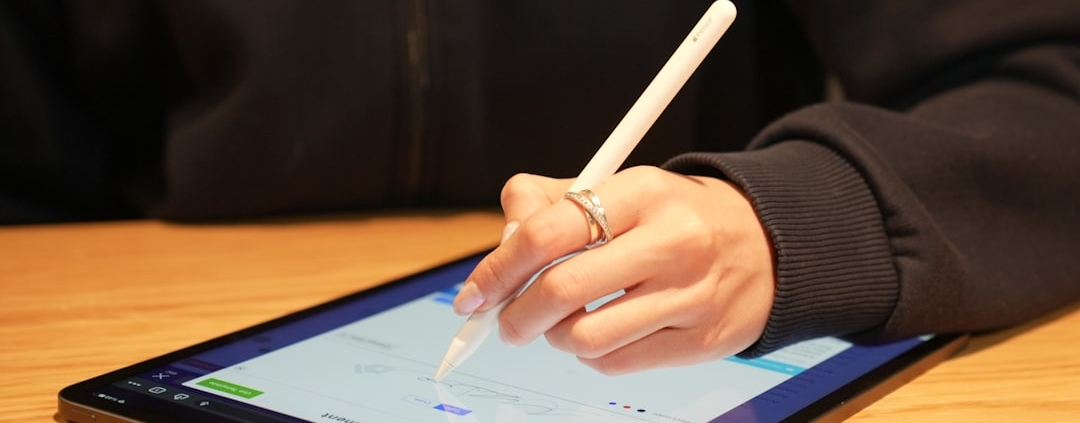
  • Ordinary electronic signatures. Anything from a typed name to a drawn signature on a PDF. Perfectly valid for most commercial contracts.
  • Advanced Electronic Signatures (AES). Cryptographically secure, tied to a verified identity, and issued by a provider accredited by the South African Accreditation Authority (SAAA). The two best-known local names are LAWtrust (now part of Altron Security) and TrustFactory.

ECTA is clear on one thing: where a document must be notarised, acknowledged, verified or sworn, an AES is required as a minimum. So when people talk about a “digital notary platform,” they usually mean one of two things. Either a signing platform that supports AES, or a service that connects you to a notary who can perform the notarial act remotely. Those are not the same thing, and it pays to know which you need.

One more important note: wills, bills of exchange, long-term leases, and sales of immovable property still cannot be signed electronically at all. Pen and paper remains the only option for those.

The quick answer to your likely questions is that there are no ads or digital signing softwares that can replace a notary’s seal for documents headed overseas. Some documents have no remote version. An antenuptial contract, a power of attorney for use abroad, a visa affidavit, anything going through apostille or embassy authentication: a notary public has to be in the room, watch you sign, and put their seal on it. That is the requirement. No platform gets around it.


Top platforms South Africans are using

1. SigniFlow

SigniFlow is the home-grown favourite. Built in South Africa and integrated with LAWtrust, it natively supports AES, which means you can use it for documents that require a higher bar of authentication. Workflow automation is its real strength: routing, approvals, templated document packs, and audit trails that hold up in a dispute. Pricing is competitive compared to the US-headquartered options, and there’s a free tier for low-volume users.

2. DocuSign

The global default. DocuSign works in South Africa, complies with ECTA for ordinary electronic signatures, and plays nicely with almost every business tool you already use – Google Workspace, Microsoft 365, Salesforce, Xero. Where it stumbles locally is AES: you’ll need to pair it with a separate accredited provider if your document requires that higher standard. For run-of-the-mill contracts, NDAs, and internal approvals, it’s excellent.

3. Adobe Acrobat Sign

If your business already lives inside Adobe’s ecosystem, Acrobat Sign is the easy choice. It handles standard electronic signatures well, offers solid identity verification add-ons, and integrates directly into the PDF workflow most offices already use. Popular with professional services firms, accountants, HR teams, and consultants — anyone who pushes a lot of PDFs and doesn’t want a separate platform to manage.

4. Zoho Sign

Zoho has quietly become a go-to for South African SMEs, partly because the pricing is gentle on a rand-denominated budget and partly because it comes bundled with the rest of the Zoho suite. It supports ECTA-compliant electronic signatures, offers blockchain-based timestamping for audit purposes, and handles multi-party signing flows without much fuss.

5. PandaDoc

PandaDoc leans into sales and proposal use cases. Quote-to-close workflows, embedded payments, and analytics on whether the other side actually read the contract before signing. For notarisation-adjacent work it’s lightweight, but for commercial contracts that need to move fast it earns its keep.

6. Dropbox Sign (formerly HelloSign)

Simple, clean, affordable. If your needs are “send this PDF, get it signed, file it away,” Dropbox Sign does that job with very little ceremony. It integrates with Dropbox, Gmail, and most cloud storage providers. Not built for complex workflows, but a solid no-friction signing tool for small teams.

When a platform is enough, and when it isn’t

Here’s where people get tripped up. A digital signature platform can handle:

  • Employment contracts and NDAs
  • Supplier and service agreements
  • Internal approvals and sign-offs
  • Most day-to-day commercial contracts

What it cannot do, regardless of the marketing copy, is replace a notary’s seal for documents headed overseas. If you need an antenuptial contract registered, a power of attorney for use in Portugal, an affidavit for a visa application, or any document that requires an apostille or embassy authentication, you need an admitted notary public to witness the signing and affix a notarial seal. No SaaS platform can skip that step.

The legality of full video-call notarisation is also still unsettled in South African law. Until the legislature or the courts give a clearer answer, the safe path for any document destined for foreign use is a notary who can meet you in person, or run a carefully structured remote process, and produce a sealed original.

Where Quick Notary fits in

We built Quick Notary for the messy middle. The documents that need more than a PDF signature but shouldn’t require you to burn a whole afternoon in a Sandton office. Our notaries are admitted attorneys, so the seal on your document holds up in any jurisdiction that recognises SA notarisation. We handle document review remotely, sort out couriering, and manage the apostille or authentication process on your behalf once signing is done.

If you’ve been going in circles trying to work out whether DocuSign is enough for your particular document, send us a WhatsApp or give us a call. We’ll tell you in plain English what you actually need, how long it’ll take, and what it’ll cost. Fast, sealed, and sorted.

How Much Does It Cost to Get a Document Notarized in South Africa 1

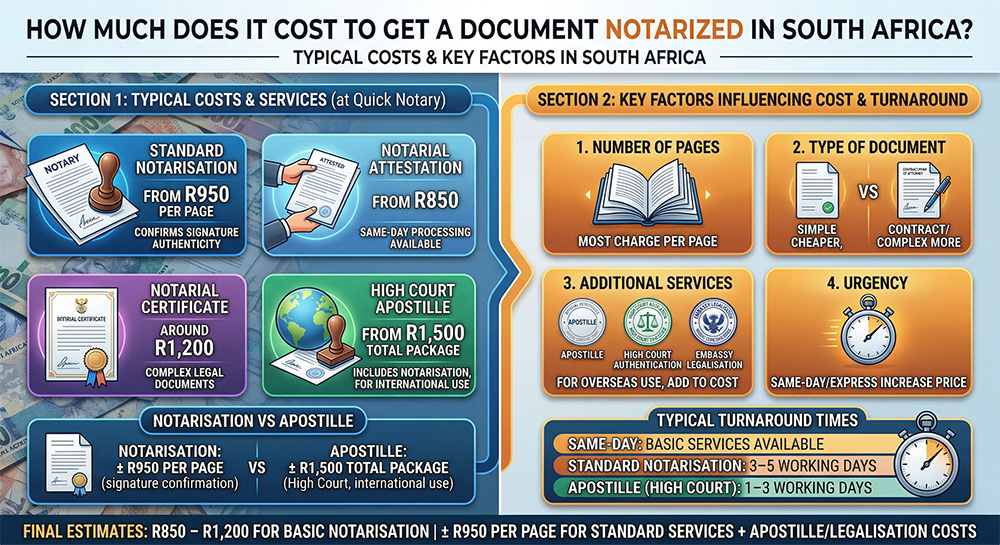
One of the first things you’ll probably ask if you need a document notarised in South Africa is how much it would cost.

The type of document, the amount of pages, and whether additional services like apostille certification are needed are some of the variables that determine the response.

This tutorial explains typical notarisation fees and what to anticipate when using a reputable service like Quick Notary.

Typical South African Notary Fees

In South Africa, notary costs are not necessarily set and might change based on the document’s complexity and the amount of legal work required.

Pricing at Quick Notary is competitive and transparent, so you have a fair idea of what to anticipate:

  • Notary Public: Starting at R950 per page for standard notarisation
  • Notarial Attestation: R850 (processing can be done the same day)
  • Notarial Certificate: around R1,200
  • High Court Apostille (including notarisation): starting at R1,500

These costs provide a reasonable estimate of what the majority of people and companies in South Africa will spend for expert notarisation services.

How Much Does It Cost to Get a Document Notarized in South Africa

What Influences Notarisation Costs?

The total cost of notarising a document can be influenced by a number of factors:

1. The quantity of pages

Longer documents will cost more because most notaries charge by the page.

2. Document Type

While sophisticated legal agreements (like contracts or powers of attorney) may require more effort, simple paperwork like affidavits are typically less expensive.

3. Extra Services

You might also require the following if your document is to be used abroad:

Apostille certification
High Court verification and legalisation of embassies

The total cost is increased by each of these steps.

4. Urgency

Although same-day or expedited services may cost more, they are frequently necessary for pressing issues.

What Is the Cost Difference Between Apostille and Notarisation?

It’s crucial to realise that notarisation is frequently only the beginning.

  • Notarisation verifies a signature’s and document’s legitimacy.
  • The document is made legally valid for use overseas by an apostille or authentication.

For instance:

  • ± R950 per page for notarisation
  • High Court route apostille: ± R1,500 total package

The country in which your document will be used will determine which procedure is best.

Does Hiring a Professional Notary Service Make Sense?

Although it could be tempting to choose the least expensive alternative, notarisation is a legal procedure that calls for precision and adherence.

Using a reputable company like Quick Notary guarantees:

  • Your documents adhere to legal requirements.
  • You stay away from rejections and delays.
  • For use abroad, the proper procedure is undertaken.

An additional degree of legal security is provided by the fact that professional notaries are also admitted attorneys.

How Much Does It Cost to Get a Document Notarized in South Africa

How Much Time Does Notarisation Take?

Depending on the service, turnaround times may differ:

  • Same-day notarisation: Available for basic services
  • Standard notarisation takes three to five business days.
  • Processing of Apostille: 1-3 working days (High Court route)

What is the price of notarising a document in South Africa, then?

Generally speaking, you should anticipate paying:

Basic notarisation costs between R850 and R1,200, or around R950 per page for regular notary services. Apostille and legalisation are extra.

The precise cost is determined by your particular document and needs, but working with a reliable supplier guarantees a quick, easy, and legally compliant process.

Do You Need a Document Notarised Right Away?

If you’re searching for dependable, quick notarisation services, Quick Notary provides:

  • Competitive rates
  • Options for same-day processing
  • Complete support for legalisation and apostille

To get a quote and have your documents handled expertly from beginning to end, contact us right now.

Who Can Notarize a Document in South Africa

Knowing who is legally permitted to notarise documents and why notarisation is vital is crucial if you require a document notarised in South Africa.

Notarisation guarantees the authenticity and legal recognition of your documents, whether you’re working with international paperwork, legal agreements, or immigration forms.

Notarisation: What Is It?

The process of confirming a document’s legitimacy and the identity of the signer is known as notarisation. A notary attests to:

  • The signer of the document is who they say they are.
  • The signature is voluntarily provided.
  • The document is run correctly.

The notary adds an official signature, seal, and certificate after verification.

In South Africa, who is able to notarise a document?

Documents in South Africa can only be notarised by a Notary Public.

A notary public is a licensed lawyer with the following qualifications:

  • Completed further legal education
  • Completed a specialist notarial exam.
  • Been recognised as a Notary by the High Court

Documents for both domestic and foreign usage may be notarised, authenticated, and certified by notaries.

Commissioners of Oaths: What About Them?

Although notaries and commissioners of oaths are sometimes confused, they are not the same.

A Commissioner of Oaths is able to:

  • Signatures from witnesses
  • Verify copies of the papers
  • Conduct affidavits

They are unable to notarise documents, nevertheless.

Documents intended for usage outside of South Africa usually need to be notarised, which is a higher level of certification.

When Is a Notary Public Necessary?

Typically, you’ll require a Notary Public for:

  • Documents utilised abroad
  • Authentication or apostille procedures
  • Powers of Attorney for use abroad
  • Business records for overseas jurisdictions
  • Verification of identity or eligibility for applications abroad

Before getting an apostille from DIRCO, notarisation is frequently the first step.

What is the role of the notary?

A notary public’s will:

  • Check your identity (typically using your passport or ID)
  • Verify the document’s validity and completeness.
  • Look at your signature.
  • Include a certificate of notarial
  • Put on a formal notarial seal.

This procedure guarantees that foreign authorities will accept the paper.

Can Documents Be Notarised by a Lawyer?

No, not all solicitors are capable of notarising papers.

Legal notarisation is limited to attorneys who have been admitted as Notaries Public. Not all lawyers are notaries, despite the fact that all notaries are attorneys.

How to Locate a South African Notary

A Notary Public can be located by:

  • Notarial services provided by law firms
  • Providers of specialised notary services
  • “Notary Public near me” searches on the internet

Need a Notary Public in South Africa? Work with Quick Notary

Quick Notary simplifies and eases the procedure if you’re searching for a quick, dependable, and expert notary service.

Their staff specialised in processing everything quickly and accurately the first time, whether you require documents notarised for international use, apostilles, or legal verification.

You can anticipate using Quick Notary:

  • Fast turnaround times
  • Unambiguous instructions about document needs
  • Help with the authentication and apostille procedures
  • Expert notarisation that complies with the law

Working with knowledgeable notaries who are familiar with both South African and foreign regulations will help you avoid delays and rejected paperwork.

Contact Quick Notary right now to have your documents accurately and promptly notarised.

If your documents are heading overseas, it is important to select a notary who has experience with foreign paperwork.

Notarisation is a specialist legal function in South Africa that can only be carried out by a certified Notary Public. Commissioners of Oaths can help with simple certifications, but when formal authentication is needed, they cannot take the place of a notary.

Working with a notary guarantees that your documents will be approved promptly and without any issues if they are meant for use abroad.