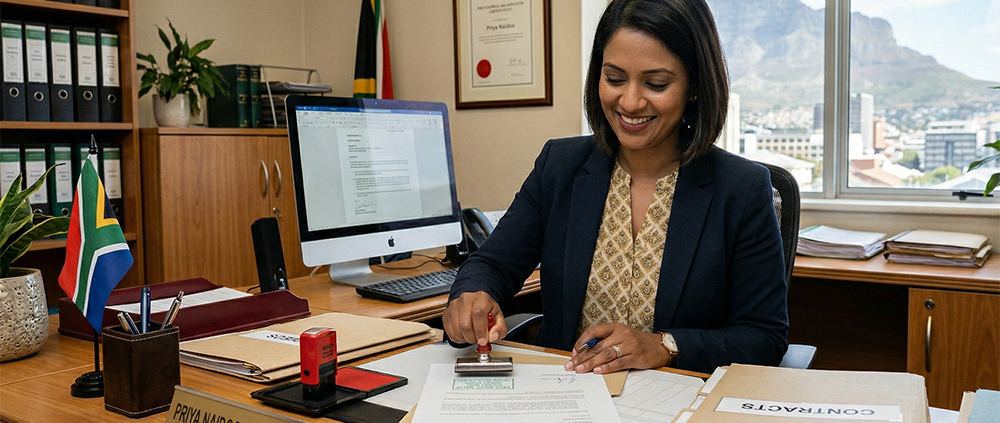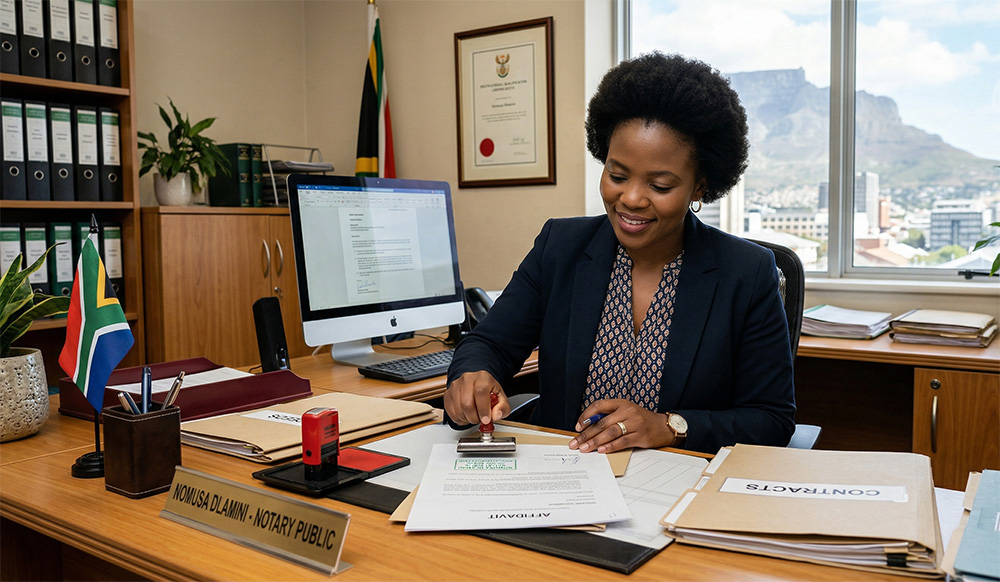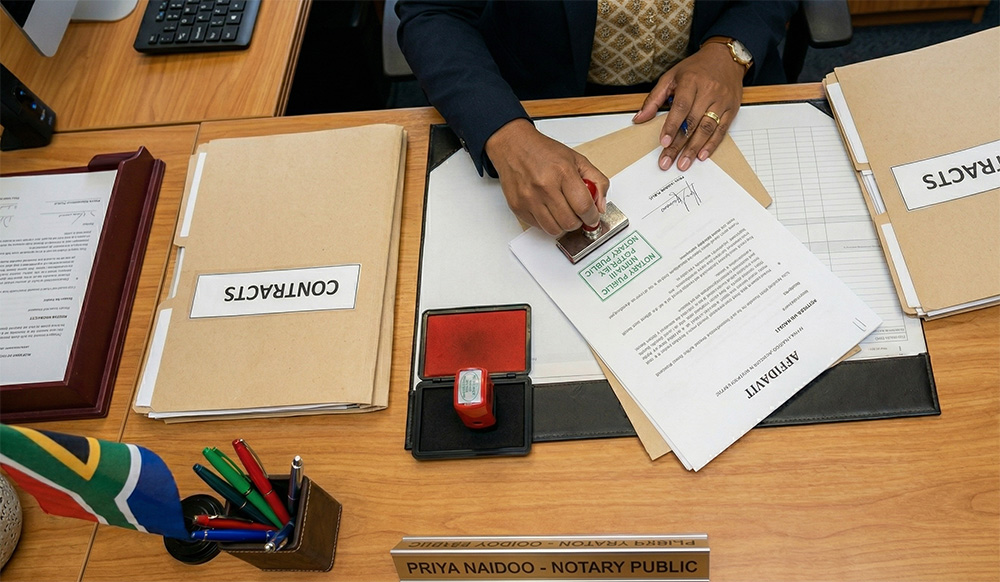

What documents do I need for a notary in South Africa?

Showing up at a notary without the right paperwork is the quickest way to waste a morning. A notarisation only holds up if the notary can verify who you are and confirm the document in front of them is the real thing, so the admin you bring matters as much as the document itself.

Here’s what a South African notary public will expect you to hand over, plus the extra paperwork needed for specific jobs like antenuptial contracts, powers of attorney, and documents headed overseas.

The basics: what every notarial appointment needs

Whatever you’re having notarised, a South African notary public will always ask for three things:

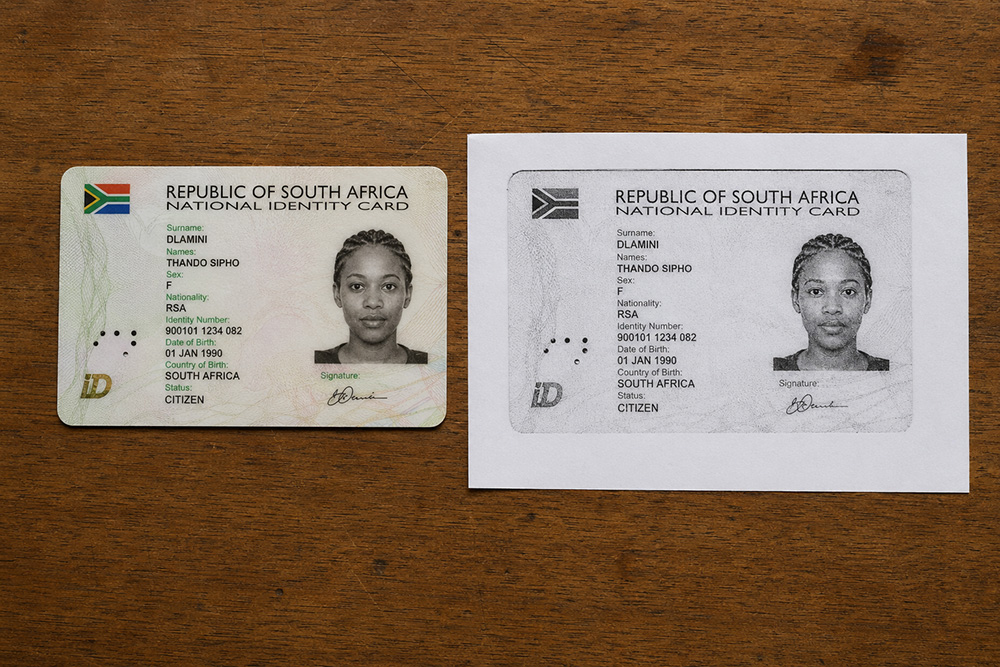
  • A valid, government-issued ID. Usually your green ID book, Smart ID card, or current passport.
  • The original document. Not a photocopy, scan, or printout of a scan.
  • You, in person, for most jobs. Identity checks can’t be done over email, and a notary has to witness your signature for it to carry weight.

Without those three, the appointment effectively doesn’t happen. Everything else below is an add-on depending on what you’re signing.
What documents do I need for a notary in South Africa

Proof of identity

Your ID is the notary’s anchor for the whole act. They’ll check it, record the details, and usually photocopy it for the file. Acceptable options are:

  • South African green ID book
  • Smart ID card
  • Valid South African passport
  • For foreign nationals: a current passport plus the relevant visa or permit

Expired IDs are a hard no, even if it’s the one you’ve been using for years. If the name on your ID doesn’t match the name on the document (common after marriage or divorce), bring the marriage certificate or divorce order so the notary can link them.

Because notaries fall under FICA, some will also ask for proof of address no older than three months. A utility bill, bank statement, or municipal rates account works. If you don’t have anything in your name, an SAPS-stamped affidavit confirming where you live is a reliable fallback.

The document itself

The document must be final, complete, and unsigned where a notarial signature is required. Notaries can’t sign over blanks, and they won’t certify a document you’ve already signed at home if the notarial wording says the signature has to happen in their presence.

If your document refers to other paperwork, like a title deed, a company resolution, or a court order, bring the originals of those too. The notary may need to reference or attach them.

Common notarial jobs and what else to bring

Affidavits and sworn statements

Bring the unsigned affidavit and your ID. That’s usually it. If the affidavit refers to supporting evidence, have it on hand in case the notary wants to attach a certified copy.

Powers of attorney

For a general or special power of attorney:

  • The draft POA, ideally prepared by an attorney
  • Your ID
  • The full names, ID numbers, and contact details of the person you’re appointing
  • If the POA is heading overseas, the name of the destination country so the notary can include the correct legalisation wording

Antenuptial contracts

Both future spouses must attend together, both carrying original IDs. You’ll also need your intended wedding date and a clear picture of any assets, debts, or inheritances you want covered in the contract. Two competent witnesses over 14 are required, though the notary’s office can usually provide them. The contract has to be signed before the wedding and lodged at the Deeds Office within three months of signing, so leave yourself a buffer.

Certified copies for overseas use or apostille

If you’re preparing documents for a Hague apostille through DIRCO or the High Court, bring the original issuing-authority document, the one with the actual seal, not a copy of a copy:

  • Unabridged birth, marriage, or death certificates from Home Affairs
  • Original police clearance from SAPS
  • Original academic transcripts and degree certificates from the university
  • Letters of no impediment issued by Home Affairs

For academic documents, some universities issue sealed transcripts directly. Those usually need to be opened in front of the notary, not before. Foreign-language documents may also need a sworn translation attached before they’ll be accepted abroad.

Company and corporate documents

If you’re signing on behalf of a business, the notary needs proof you’re authorised to do so:

  • Your ID
  • The company’s CIPC registration certificate
  • A board or directors’ resolution naming you as signatory
  • Memorandum of Incorporation, if the resolution refers to it

For foreign transactions, add anything the receiving jurisdiction has asked for: a certificate of good standing, shareholder register, or tax clearance.

Travel consent for minors

  • Both parents’ IDs, or one parent’s ID plus custody or guardianship documents
  • The child’s unabridged birth certificate
  • The draft consent letter with the travel dates and destination

What trips people up

A handful of small things cause most rejected notarisations:

  • Expired IDs and passports
  • Documents signed in advance of the appointment
  • Photocopies where the foreign authority expects originals
  • Name mismatches between ID and document, with no supporting certificate to explain the change
  • Foreign-language documents sent in without a sworn translation

It’s worth emailing scans through ahead of your appointment so the notary can flag any of these before you drive across town.

Make the appointment a one-trip job

Quick Notary’s team reviews your paperwork before you arrive, tells you exactly which originals to bring, and handles the apostille or authentication leg if your documents are bound for use overseas. That saves a return trip, and more importantly, stops a foreign consulate or DIRCO counter from bouncing your paperwork weeks down the line.

If you have a notarisation coming up and you’re not sure what to bring, send the document through. We’ll tell you what’s needed, book you in, and get it stamped, sealed, and on its way.
How Much Does It Cost to Get a Document Notarized in South Africa 1

One of the first things you’ll probably ask if you need a document notarised in South Africa is how much it would cost.

The type of document, the amount of pages, and whether additional services like apostille certification are needed are some of the variables that determine the response.

This tutorial explains typical notarisation fees and what to anticipate when using a reputable service like Quick Notary.

Typical South African Notary Fees

In South Africa, notary costs are not necessarily set and might change based on the document’s complexity and the amount of legal work required.

Pricing at Quick Notary is competitive and transparent, so you have a fair idea of what to anticipate:

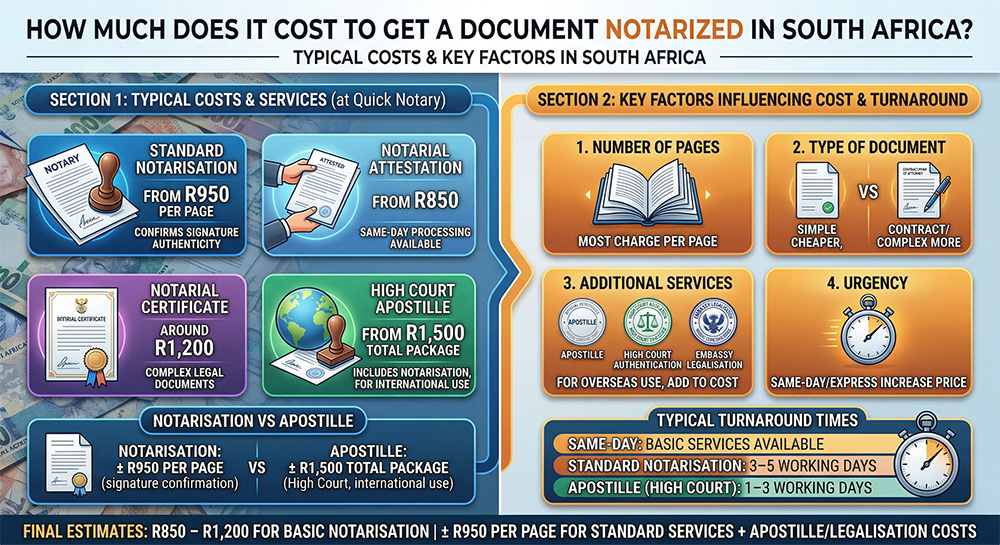
  • Notary Public: Starting at R950 per page for standard notarisation
  • Notarial Attestation: R850 (processing can be done the same day)
  • Notarial Certificate: around R1,200
  • High Court Apostille (including notarisation): starting at R1,500

These costs provide a reasonable estimate of what the majority of people and companies in South Africa will spend for expert notarisation services.

How Much Does It Cost to Get a Document Notarized in South Africa

What Influences Notarisation Costs?

The total cost of notarising a document can be influenced by a number of factors:

1. The quantity of pages

Longer documents will cost more because most notaries charge by the page.

2. Document Type

While sophisticated legal agreements (like contracts or powers of attorney) may require more effort, simple paperwork like affidavits are typically less expensive.

3. Extra Services

You might also require the following if your document is to be used abroad:

Apostille certification
High Court verification and legalisation of embassies

The total cost is increased by each of these steps.

4. Urgency

Although same-day or expedited services may cost more, they are frequently necessary for pressing issues.

What Is the Cost Difference Between Apostille and Notarisation?

It’s crucial to realise that notarisation is frequently only the beginning.

  • Notarisation verifies a signature’s and document’s legitimacy.
  • The document is made legally valid for use overseas by an apostille or authentication.

For instance:

  • ± R950 per page for notarisation
  • High Court route apostille: ± R1,500 total package

The country in which your document will be used will determine which procedure is best.

Does Hiring a Professional Notary Service Make Sense?

Although it could be tempting to choose the least expensive alternative, notarisation is a legal procedure that calls for precision and adherence.

Using a reputable company like Quick Notary guarantees:

  • Your documents adhere to legal requirements.
  • You stay away from rejections and delays.
  • For use abroad, the proper procedure is undertaken.

An additional degree of legal security is provided by the fact that professional notaries are also admitted attorneys.

How Much Does It Cost to Get a Document Notarized in South Africa

How Much Time Does Notarisation Take?

Depending on the service, turnaround times may differ:

  • Same-day notarisation: Available for basic services
  • Standard notarisation takes three to five business days.
  • Processing of Apostille: 1-3 working days (High Court route)

What is the price of notarising a document in South Africa, then?

Generally speaking, you should anticipate paying:

Basic notarisation costs between R850 and R1,200, or around R950 per page for regular notary services. Apostille and legalisation are extra.

The precise cost is determined by your particular document and needs, but working with a reliable supplier guarantees a quick, easy, and legally compliant process.

Do You Need a Document Notarised Right Away?

If you’re searching for dependable, quick notarisation services, Quick Notary provides:

  • Competitive rates
  • Options for same-day processing
  • Complete support for legalisation and apostille

To get a quote and have your documents handled expertly from beginning to end, contact us right now.

Who Can Notarize a Document in South Africa

Knowing who is legally permitted to notarise documents and why notarisation is vital is crucial if you require a document notarised in South Africa.

Notarisation guarantees the authenticity and legal recognition of your documents, whether you’re working with international paperwork, legal agreements, or immigration forms.

Notarisation: What Is It?

The process of confirming a document’s legitimacy and the identity of the signer is known as notarisation. A notary attests to:

  • The signer of the document is who they say they are.
  • The signature is voluntarily provided.
  • The document is run correctly.

The notary adds an official signature, seal, and certificate after verification.

In South Africa, who is able to notarise a document?

Documents in South Africa can only be notarised by a Notary Public.

A notary public is a licensed lawyer with the following qualifications:

  • Completed further legal education
  • Completed a specialist notarial exam.
  • Been recognised as a Notary by the High Court

Documents for both domestic and foreign usage may be notarised, authenticated, and certified by notaries.

Commissioners of Oaths: What About Them?

Although notaries and commissioners of oaths are sometimes confused, they are not the same.

A Commissioner of Oaths is able to:

  • Signatures from witnesses
  • Verify copies of the papers
  • Conduct affidavits

They are unable to notarise documents, nevertheless.

Documents intended for usage outside of South Africa usually need to be notarised, which is a higher level of certification.

When Is a Notary Public Necessary?

Typically, you’ll require a Notary Public for:

  • Documents utilised abroad
  • Authentication or apostille procedures
  • Powers of Attorney for use abroad
  • Business records for overseas jurisdictions
  • Verification of identity or eligibility for applications abroad

Before getting an apostille from DIRCO, notarisation is frequently the first step.

What is the role of the notary?

A notary public’s will:

  • Check your identity (typically using your passport or ID)
  • Verify the document’s validity and completeness.
  • Look at your signature.
  • Include a certificate of notarial
  • Put on a formal notarial seal.

This procedure guarantees that foreign authorities will accept the paper.

Can Documents Be Notarised by a Lawyer?

No, not all solicitors are capable of notarising papers.

Legal notarisation is limited to attorneys who have been admitted as Notaries Public. Not all lawyers are notaries, despite the fact that all notaries are attorneys.

How to Locate a South African Notary

A Notary Public can be located by:

  • Notarial services provided by law firms
  • Providers of specialised notary services
  • “Notary Public near me” searches on the internet

Need a Notary Public in South Africa? Work with Quick Notary

Quick Notary simplifies and eases the procedure if you’re searching for a quick, dependable, and expert notary service.

Their staff specialised in processing everything quickly and accurately the first time, whether you require documents notarised for international use, apostilles, or legal verification.

You can anticipate using Quick Notary:

  • Fast turnaround times
  • Unambiguous instructions about document needs
  • Help with the authentication and apostille procedures
  • Expert notarisation that complies with the law

Working with knowledgeable notaries who are familiar with both South African and foreign regulations will help you avoid delays and rejected paperwork.

Contact Quick Notary right now to have your documents accurately and promptly notarised.

If your documents are heading overseas, it is important to select a notary who has experience with foreign paperwork.

Notarisation is a specialist legal function in South Africa that can only be carried out by a certified Notary Public. Commissioners of Oaths can help with simple certifications, but when formal authentication is needed, they cannot take the place of a notary.

Working with a notary guarantees that your documents will be approved promptly and without any issues if they are meant for use abroad.

What Is the Difference Between a Notary and a Lawyer in South Africa

Many individuals think that a notary and a lawyer are the same when it comes to legal paperwork. Even though they are both licensed solicitors, their functions in the South African legal system are substantially different.

You can ensure that your documents are treated correctly and save time and money by being aware of the differences.

What Is a Lawyer?

A lawyer, sometimes referred to as an attorney, is a certified legal practitioner who can offer broad legal services and advice.

Attorneys can help with:

  • Litigation and legal conflicts
  • Agreements and contracts
  • Transactions involving real estate
  • Business-related legal issues
  • Family law (custody, divorce, etc.)

They can appear in court on your behalf, offer legal advice, and represent clients.

What Is a Notary Public?

A notary public is a particular kind of attorney who has fulfilled additional requirements and been authorised by the High Court to carry out particular legal duties.

Notaries concentrate on:

  • Verifying and authenticating papers
  • Observing and verifying signatures
  • Notarial deed drafting
  • Getting documents ready for usage abroad
  • Making sure documents adhere to stringent legal requirements

They serve as unbiased legal authorities, which increases the trustworthiness of papers.

Important Distinctions Between a Lawyer and a Notary


1. Work Scope

Attorney:
manages a variety of legal issues, such as disagreements, counsel, and representation.

Notary:
focuses on formal legal documents, certification, and document authentication.

2. Specialisation Level

Attorney:
general legal education in a variety of legal fields.

Notary:
Exams and additional specialised training centred on notarial work.

3. Legal Weight and Authority

Attorney:
able to create and offer document advice.

Notary:
able to formally authenticate documents, granting them legal recognition, particularly for use in governmental and international contexts.

4. Global Acknowledgement

Attorney:
Lawyer-prepared documents might not be accepted abroad without additional certification.

Notary:
Notarised documents are widely accepted around the world and are frequently needed for:

  • Immigration
  • Studying overseas
  • International business dealings
  • Contracts with other countries


5. Document Types Managed

Attorney:

  • Contracts in general
  • Documents providing legal guidance
  • Court-related documents

Notary:

  • Antenuptial agreements
  • Notarial bonds
  • Documents prepared for apostille
  • Attorney powers for use overseas
  • Certified copies for usage abroad

When Is a Lawyer Needed?

A lawyer should be consulted when you need:

  • Legal counsel
  • Legal representation
  • Assistance in resolving conflicts
  • Drafting general contracts
What Is the Difference Between a Notary and a Lawyer in South Africa

When Is It Appropriate to Use a Notary?

A notary should be used when:

  • Official certification or authentication is required for your documents.
  • Outside of South Africa, documents are being used
  • Antenuptial agreements and other formal legal documents are being signed by you.
  • You require legalisation or apostille services.

Can a lawyer serve as a notary public?

Only if they meet the requirements and are accepted as a Notary Public.

Not all solicitors are notaries. To carry out notarial obligations, a notary must pass additional tests and be formally constituted.

Why This Distinction Is Important

Choosing the incorrect expert can result in:

  • Rejected documents
  • Legal or international procedures delays
  • Extra expenses to fix errors

Selecting the appropriate specialist guarantees that your documents are initially recognised and have legal validity.

Although they both play crucial roles in South Africa’s legal system, notaries and solicitors have different responsibilities.

A lawyer assists you in resolving legal issues and conflicts.
A notary guarantees the correct execution, authenticity, and legal recognition of your documents.

Knowing this distinction enables you to choose the best option for your unique requirements.

In South Africa, do you need a notary?

Our speciality at Quick Notary is providing prompt, trustworthy notarial services for both domestic and foreign needs.

We can help with notarisation, certification, and document preparation for usage overseas.

Get in touch with us now to begin.

How to Book an Online Notary Appointment in South Africa

There was a time when getting documents notarised meant taking half a day off work, driving to an attorney’s office somewhere in the CBD, sitting in a waiting room, and hoping the notary could squeeze you in. For most people, it was a hassle — and for those living in smaller towns, or South Africans living abroad who needed local documents sorted, it could be a real headache.

Things have changed. Booking a notary appointment in South Africa is now far more straightforward, and for many types of documents, you don’t even need to leave your house to get the process started. Here’s everything you need to know.

Can You Really Use a Notary Online in South Africa?

Sort of, and it’s worth being precise here, because there’s a common misconception.

In South Africa, certain parts of the notarial process can happen remotely (sending documents electronically, communicating via email or WhatsApp, making payment online), but the actual notarisation — the moment the notary witnesses your signature, verifies your identity, and applies their official seal — still typically requires a physical meeting or the submission of original documents.

This is because South African law requires a notary to:

  • Physically verify your identity (usually via a valid ID or passport)
  • Witness you signing the document in person (for certain document types)
  • Apply their official notarial seal to the original document

That said, services like Quick Notary have made the process dramatically more convenient by handling everything else remotely — the consultation, document review, communication, and courier logistics — so the actual in-person component is minimal and well-organised.

How to Book an Online Notary Appointment in South Africa

Step-by-Step: How to Book a Notary Appointment in South Africa

Step 1: Figure Out What You Need

Before you contact any notary, it helps to know what type of document you need notarised and what it will be used for. This matters because the process differs depending on:

  • The document type — is it an ante-nuptial contract, a power of attorney, a certified copy, an affidavit, or something else?
  • Where it will be used — locally, or internationally? If internationally, is the destination country part of the Hague Convention (apostille required) or not (embassy authentication required)?
  • Who it’s for — personal use, business, or immigration purposes?

If you’re not sure, don’t worry. A good notarial service will help you figure this out during your initial consultation.

Step 2: Reach Out to a Notary Service

Once you have a rough idea of what you need, the next step is making contact. With Quick Notary, you have a few options:

  • Email: Send a message to info@quicknotary.co.za with details about your documents and what you need
  • WhatsApp: Message the Quick Notary team directly — this is often the fastest way to get a quick answer about your specific situation
  • Phone: Call during office hours (Monday to Friday, 8am–5pm)

When you make contact, give as much context as you can: what the document is, where it needs to be used, and how urgently you need it. This helps the notary advise you correctly from the start and avoids unnecessary back-and-forth.

Step 3: Document Review

Once you’ve made contact, the team will review your documents. You can usually send scanned copies or photos via email or WhatsApp at this stage — this is where the “online” part really comes in handy.

The notary will check:

  • That your documents are complete and suitable for notarisation
  • Whether any additional requirements apply (e.g. if an apostille is needed on top of notarisation)
  • What the correct process is for your specific situation

This review stage is important and genuinely saves time. It means when you do come in (or send in your originals), everything is already prepared and ready to go.

Step 4: Identity Verification and Signing

This is the step that still typically requires some form of direct contact. Depending on your document type, you’ll either:

  • Come in person to the Quick Notary office in Fourways, Sandton to sign in the presence of the notary and have your identity verified
  • Send your original documents via secure courier for certification and authentication

For most clients, this step is actually quite quick — because the preparation work has already been done remotely, the in-person visit or courier submission is streamlined and efficient.

Make sure to bring (or include with your documents):

  • A valid South African ID or passport
  • The original documents that need to be notarised (in most cases)
  • Any supporting documents that may be required for your specific application

Step 5: Notarial Seal and Certification

Once your identity has been verified and you’ve signed the relevant documents, the notary applies their official seal and signature. This is what gives your documents their legal weight — both locally and internationally.

At Quick Notary, this typically takes 3 to 5 working days for standard processing.

Step 6: Apostille or Embassy Authentication (If Required)

If your documents are heading overseas, there’s usually one more step. Quick Notary handles this for you too:

  • For Hague Convention countries (most of Europe, the US, Australia, UK, etc.) — the documents are submitted to DIRCO for apostille certification
  • For non-Hague countries — the documents go through the relevant embassy or High Commission for legalisation

This can be arranged as part of the same service, with courier delivery directly to your door once everything is complete.

What Documents Do You Need to Prepare?

This varies by document type, but generally you’ll want to have:

  • Your original documents — the ones that need to be notarised
  • A valid ID or passport — for identity verification
  • Supporting documents — for example, if you’re getting an ante-nuptial contract notarised, you’ll need details of the marriage and both parties’ IDs; for a power of attorney, the name and details of the person receiving authority

If you’re unsure what to bring, just ask when you make your initial enquiry. The Quick Notary team can give you a clear list specific to your situation.

How Much Does It Cost?

Quick Notary’s current pricing is:

  • Notary Public services: R950.00 per page
  • High Court Apostille: R875.00

These are standard, transparent fees with no hidden surprises. When you make your initial enquiry, you’ll get a clear picture of what the total cost will be based on your specific documents and requirements.

Tips for a Smooth Notary Appointment

A few things that make the process go more smoothly:

Get in touch early. If you have a deadline — a visa application, an international admission deadline, or a property transaction — don’t leave this to the last minute. Standard processing is 3 to 5 working days, and apostille processing adds additional time. Build in a buffer.

Send good quality scans. When submitting documents for initial review, clear, legible scans or photos make it easier for the notary team to assess your documents quickly.

Have your ID ready. You’ll need a valid South African ID document or passport for identity verification. Make sure it’s not expired.

Ask about courier options. If you can’t come in person, Quick Notary offers courier collection and delivery — so you can manage the whole thing without setting foot in an office.

Be clear about the destination. If your documents are going abroad, make sure you know which country they’re going to. This determines whether you need an apostille or embassy authentication, and knowing this upfront saves time.

How to Book an Online Notary Appointment in South Africa

Why Choose Quick Notary?

Quick Notary is based in Fourways, Sandton, and serves clients across South Africa — including individuals, businesses, expats, and anyone needing documents legalised for international use. The team consists of admitted attorneys and experienced notaries who understand both South African legal requirements and international document standards.

What makes the process genuinely easier is the combination of remote communication and professional handling. You can sort out most of the preparation online, via WhatsApp or email, and then simply arrange for your documents to be submitted and processed — without the traditional rigmarole of trying to track down a notary, book an appointment weeks in advance, and hope they understand what you need.

It’s also worth noting that Quick Notary handles the full chain of services — notarisation, apostille, DIRCO submission, and courier delivery — under one roof. That means you’re not juggling multiple service providers for what can already be a stressful process.

Ready to Get Started?

If you need documents notarised, apostilled, or authenticated for use in South Africa or abroad, reach out to Quick Notary today.

📧 info@quicknotary.co.za 📱 WhatsApp the team 📍 Fourways, Sandton — with courier collection and delivery available nationwide

Office hours: Monday to Friday, 8:00am – 5:00pm | Saturday, 8:00am – 12:00pm

What Is the Role of a Notary in South African Legal Processes

A Notary Public may be required when handling significant legal papers in South Africa. What precisely do notaries perform, though, and why are they so crucial to legal procedures?

This tutorial explains what a notary does in South Africa, when you need one, and how they can help make sure your documents are both legally and globally acknowledged.

What Does a South African Notary Public Do?

The High Court of South Africa appoints a Notary Public, a specialised lawyer who has passed additional tests.

A notary has the power to carry out particular legal tasks, such as authentication, certification, and the writing of specified formal documents, in contrast to an ordinary attorney.

Notaries are trusted public servants in the judicial system because they are held to a higher standard of care and impartiality.

What Is the Role of a Notary in South African Legal Processes

The Fundamental Function of a Notary

A notary’s primary responsibility is to guarantee the legitimacy, dependability, and authenticity of documents and legal transactions.

These are the main duties:

1. Identity Verification and Fraud Prevention

A notary attests to:

  • The signer’s identity
  • that they comprehend the information
  • something they voluntarily sign

This procedure guarantees legal integrity and aids in the prevention of fraud.

2. Observing and Verifying Signatures

Notaries serve as impartial witnesses when significant documents are signed.

Their official seal and signature attest to the following:

  • The signature on the document was accurate.
  • The parties were correctly recognised.

This gives the document more legitimacy and legal weight.

3. Verifying Documents for Lawful Use

Notaries attest to the authenticity and validity of papers.

This comprises:

Document acceptance in legal, business, and governmental processes is guaranteed by their certification.

4. Creating Notarial Contracts and Deeds

For some legal documents to be legitimate, a notary must prepare them.

Among them are:

  • Antenuptial agreements
  • Notarial leases
  • Notarial ties and servitudes

The legal enforceability of these documents is higher.

5. Giving Declarations and Oaths

Oaths and affirmations can be administered by notaries for:

  • Affidavits
  • Statements of law
  • Statutory proclamations

This is frequently necessary for official submissions or legal procedures.

6. Getting Documents Ready for Global Use

Helping documents be accepted overseas is one of a notary’s most significant responsibilities.

They

  • Notarise documents for usage abroad.
  • Help with legalisation and apostilles
  • Verify adherence to international legal requirements

This is necessary for:

  • Immigration
  • Studying overseas
  • Global commerce
  • Transactions involving foreign property

International recognition is far more likely for documents that have been notarised by a notary.

The Significance of Notaries in South African Legal Procedures

In both domestic and foreign transactions, notaries are essential to preserving confidence and legal certainty.

Their participation guarantees:

  • Documents have legal validity.
  • Transactions are carried out correctly.
  • There is less chance of fraud.
  • Documents are applicable worldwide.

A document is often deemed totally genuine only after it has been notarised.

What Is the Role of a Notary in South African Legal Processes

What Makes a Commissioner of Oaths Different from a Notary?

A Notary Public and a Commissioner of Oaths are frequently confused.

Commissioner of Oaths:

able to attest to signatures and certify copies
mostly utilised locally

Notary Public:

  • Possesses specific legal power
  • Necessary for official legal papers
  • Crucial for use abroad

In summary, notaries are needed for more complicated or globally recognised papers and function at a higher legal level.

When Is a Notary Necessary?

A notary is usually required when handling:

  • Documents being sent abroad
  • Agreements pertaining to property
  • Contracts for marriage (ante-nuptial agreements)
  • Attorney powers
  • Commercial or business contracts
  • Certified copy for usage abroad
  • Concluding Remarks

As a reliable authority who guarantees that documents are genuine, correctly completed, and legally binding, a notary public is essential to South Africa’s legal system.

Working with a notary gives you the assurance that your documents will withstand legal scrutiny both domestically and internationally, whether you’re dealing personal, business, or international affairs.

Need a Notary in South Africa?

We at Quick Notary make notarisation quick, easy, and dependable. Our staff can assist you with notarising, authenticating, or preparing papers for usage abroad.

Get in touch with us now to begin.