
You’ve got the Certificate of Sponsorship in your inbox, the start date is six weeks out, and your new manager in Manchester is already asking about onboarding. Then comes the email from your immigration solicitor: please send the apostilled originals of the following documents. Just like that, your Skilled Worker visa application has turned into a paperwork project you didn’t plan for.
The UK is one of the easier destinations for South African paperwork, but only if you understand which documents need to be notarised, which need to be apostilled, and in which order. Get the order wrong and your visa lodgement slips by weeks.
The good news: the UK is a Hague country
The UK has been part of the Hague Apostille Convention since 1965, and South Africa joined in 1995. That means a single apostille certificate from DIRCO or the High Court of South Africa is enough, UK Visas and Immigration won’t ask you to send anything to the British High Commission for further legalisation.
Compare that to South Africans heading to the UAE or Saudi Arabia for a similar role and you’ll appreciate the difference. One stamp, one route, done.
When notarisation comes into the picture
Apostille and notarisation aren’t the same thing, and people lose weeks confusing the two.
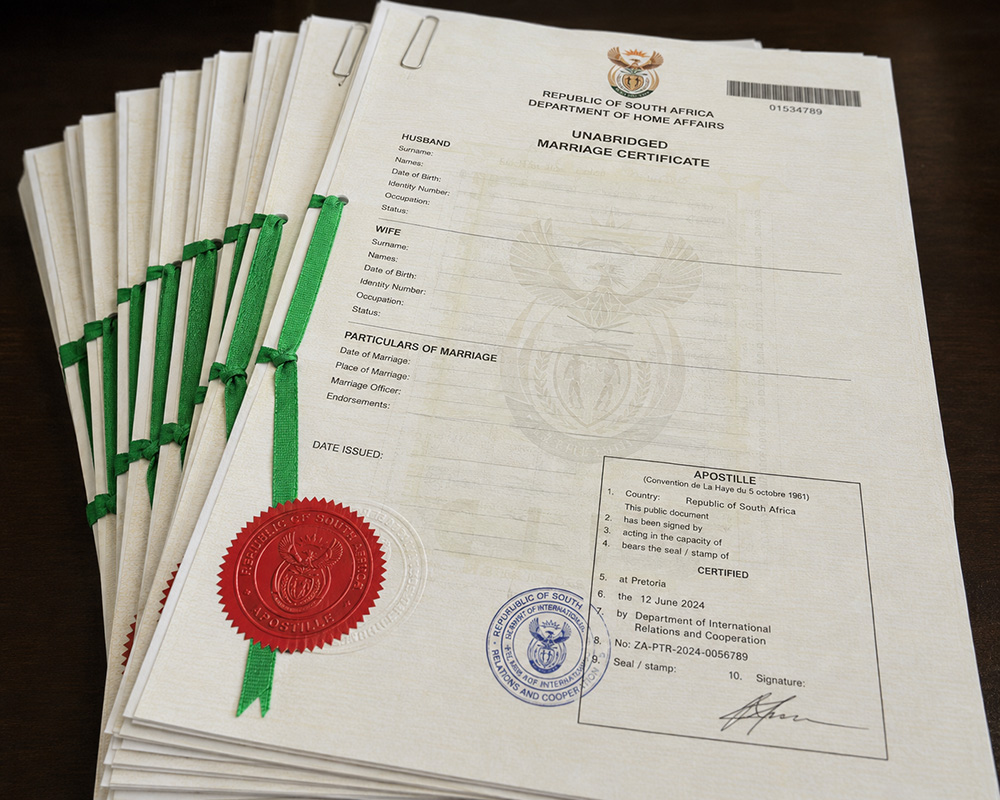
An apostille is a government-issued certificate that confirms the official document underneath it is genuine. DIRCO and the High Court can apostille public documents ( things issued by Home Affairs, SAPS, or a recognised university) directly.
Notarisation happens before that. A notary public (an admitted attorney with extra qualifications) certifies private documents, copies, signatures, or sworn statements so that they become eligible for an apostille. The High Court will only apostille a document that has a notary’s signature and seal on it. DIRCO will only apostille originals issued by the state.
So the question for every document on your Skilled Worker pack is: does this go straight to DIRCO, or does it need a notary first?
The Skilled Worker document list, sorted
Here’s how the typical Skilled Worker bundle breaks down for a South African applicant.
Goes straight for an apostille (no notary needed)
- Unabridged birth certificate: original from Home Affairs, for you and any dependants
- Unabridged marriage certificate: if you’re bringing a spouse
- Decree of divorce: if you’ve been married before and your new partner is on the application
- South African Police Clearance Certificate: original SAPS document with the embossed seal
- Degree certificates and academic transcripts: only if issued by a public South African university with original signatures and seals (private institutions and older qualifications often need a notary first)
Needs notarisation first, then an apostille
- Sworn affidavits: for example, confirming cohabitation history or a name change
- Notarised copies of your passport: UK Visas and Immigration sometimes want a certified copy if your original is in use elsewhere
- Powers of attorney: typically for someone in SA managing your bond, your tenants, or a sale while you settle in the UK
- Translations: if any document is not already in English (rare for South African paperwork, but it happens with older Afrikaans-only certificates)
- Letters from former employers, accountants, or universities: the notary verifies the signatory’s identity and signature
- Statutory declarations: used for things like single-status confirmation or proof of dependant relationships
A useful rule of thumb: if a real human signed it on company letterhead, it probably needs a notary. If a government department issued it with a seal, it probably doesn’t.
Documents the Skilled Worker route doesn’t actually need apostilled
Some documents UK Visas and Immigration ask for don’t need any of this faff at all. Your Certificate of Sponsorship is a digital reference number, there’s nothing to apostille. Your TB test certificate comes from a Home Office-approved clinic in Sandton or Cape Town and goes in as-is. Your financial evidence showing the £1,270 sat in your account for 28 days is just a bank statement.
The trap is that people assume everything needs an apostille and end up paying to apostille things that should have stayed plain. Save yourself the cost.
Timing and why it bites
UK Skilled Worker applications run on a 90-day window from the date your CoS is issued, which sounds generous until you’re chasing a SAPS fingerprint result.
A realistic timeline for South African applicants:
- SAPS police clearance: 14 to 20 working days for the certificate itself
- Notarisation: same-day for most jobs, if the notary is responsive
- High Court apostille: roughly 3 working days
- DIRCO apostille: 3 to 4 weeks on a normal week, 6 to 8 weeks during peak periods
The High Court route is faster but only available for documents that have been notarised first. DIRCO is the only route for state-issued originals like Home Affairs certificates and SAPS clearances.
Don’t ignore what’s happening on the UK side either. The general salary threshold sits at £38,700 and is set to climb to £41,700, and policy keeps tightening. The faster you submit, the less rule-shifting you have to manage.
What tends to derail people
A few patterns we see almost every week:
- Applying for the apostille before the document was properly notarised. The High Court rejects it, two weeks gone.
- Sending an abridged birth certificate to DIRCO. Since the September 2024 tightening, only unabridged originals are accepted.
- Booking the TB test before checking the clinic is on the Home Office list — results from anywhere else are invalid.
- Assuming a JP-certified copy will work. JPs can certify for South African purposes, but UKVI and DIRCO want a notary’s seal.
- Leaving the apostille step until after lodgement, then scrambling when the Home Office requests originals.
Most of these are five-minute mistakes that cost three weeks to undo.
Where we fit in
Quick Notary handles the whole chain for Skilled Worker applicants, notarising what needs notarising in-house (our notaries are admitted attorneys), running documents to DIRCO or the High Court, and couriering finished packs to wherever you are. London, Edinburgh, Belfast, Aberdeen, we’ve shipped to all of them, and to a fair few villages no one outside the UK has heard of.
If you’ve just received your CoS and you’re staring at the document list wondering what goes where, send us your sponsor’s request list on WhatsApp and we’ll map out the right route for each item. A planning call costs you nothing, and tends to save the kind of timeline panic that makes the start date wobble.
